| |||||||||
The Two Clocks | |||||||||
Six days before the EU AI Act's obligations for standalone high-risk systems were due to apply, the date moved to December 2027. The standards and implementation machinery that would have made those rules workable were not ready. Nothing about the underlying accountability moved with the date. August's two articles sit either side of that observation. The Deadline Moved examines what a deferral reveals about Boards which had anchored AI governance to a regulatory date: the programmes that quietly paused, the ones that carried on because they were built around the decisions the organisation was actually making, and the duties that the Act never conferred in the first place. The Debugging Gap looks at the other clock, the one no legislator controls. Two experiments, two labour-market datasets and one telemetry study now point the same way: AI produces more code that someone must check, while absorbing the debugging and review work through which people learned to check it, at a moment when fewer are entering the profession. The governance variable, the article argues, is how the tools are used, not whether they are available. Read together they describe two clocks running at different speeds. The regulatory clock is negotiable, and August proved it. The capability clock is not: a verification workforce takes years to form and can be thinned in a single procurement cycle. Boards treating the deferral as breathing space have read the wrong dial. The AI Regulation and AI & the Workforce briefings hold the standing questions on each, and the Automated Reasoning signal is worth your time for the narrow class of controls where formal proof, rather than testing, is now the stronger assurance. If your time is limited, I particularly recommend The Debugging Gap, and one action with it: ask at your next Board meeting who in the organisation is genuinely qualified to check the AI-generated work you are already shipping, and how that number moves over the next three years. It is an answerable question, and the answer is rarely comfortable. How is your organisation building the capability it will need on the assumption that no deadline will arrive to require it? — Mario | |||||||||
This Month's Articles | |||||||||
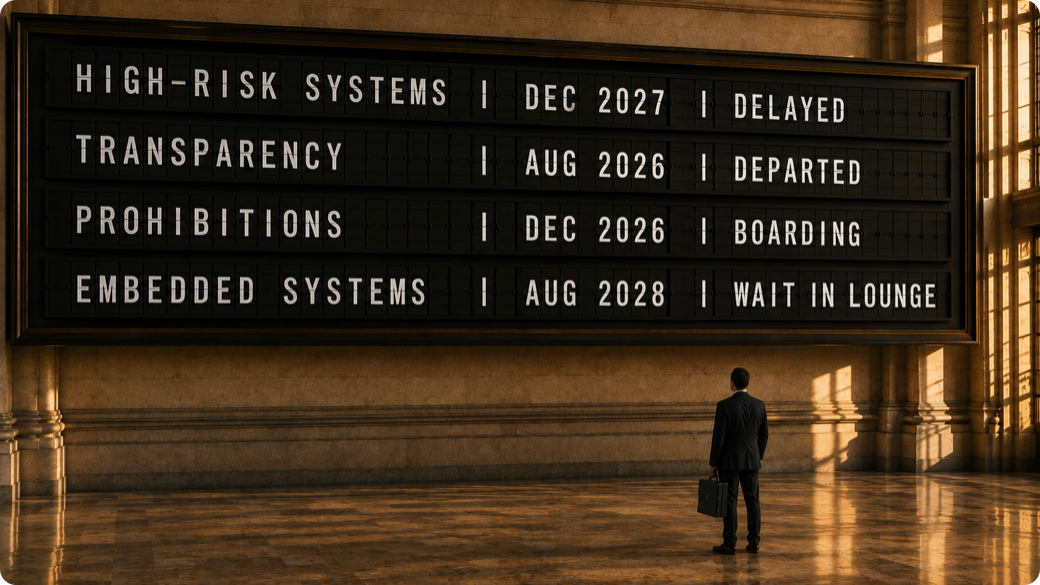 | |||||||||
9 August 2026 · 10 minute read This article examines the amendment that pushed the AI Act's standalone high-risk obligations from August 2026 out to December 2027, and what a moving deadline exposes about governance built around a date rather than a decision. It separates the obligations that shifted from the accountability that did not, and sets out where directors should re-anchor their oversight. Read article → | |||||||||
 | |||||||||
29 August 2026 · 10 minute read This article defines the Debugging Gap as the widening distance between the volume of AI-generated code needing repair and the number of people able to repair it. Drawing on controlled experiments, labour-market data and telemetry, it traces how verification demand rises while the apprenticeship route that produced verifiers narrows, and treats patterns of tool use as the governance lever available to Boards now. Read article → | |||||||||
Board Briefings | |||||||||
Board Briefings are my standing references for directors: each one takes a single governance topic and sets out what a Board needs to know, ask, and decide. | |||||||||
What fragmented AI regulation demands of directors Read the briefing → | |||||||||
Talent, skills, and the people side of adoption Read the briefing → | |||||||||
Signals | |||||||||
Signals are my short readings of developments worth a Board’s attention: what changed, why it matters, and what to watch next. | |||||||||
Emerging Formal logic and mathematical proof, industrialised. For some precisely specified, high-consequence controls, testing is no longer the strongest assurance available. View the signal → | |||||||||
Emerging AI that acts in the physical world, from factory humanoids to autonomous machines. The liability, capital, and workforce questions are already Board-level. View the signal → | |||||||||
Listen to the Podcast | |||||||||
| |||||||||
Remake | |||||||||
When AI changes how you work, lead it before it leads you. Remake is my framework for remaking a business around AI: the stages the change moves through, the assets the Board signs off, and the verdicts that keep it honest. Explore Remake → | |||||||||
 I lead the remaking of businesses around AI and emerging technology: executing it inside the business and advising the Boards accountable for it. Head of Applied AI & Emerging Technology Strategy at AWS, Chartered Director and Fellow of the Institute of Directors, and creator of Remake and The Great Remaking.         Copyright © 2003-2026 Mario Thomas |