I use cookies to understand how my website is used. This data is collected and processed directly by me, not shared with any third parties, and helps us improve our services. See my privacy and cookie policies for more details.
Tagged with: #future-of-work
Posts tagged with #future-of-work explore how leaders can navigate workforce transformation and keeping a “human in the loop” in an era of intelligent automation and augmentation.
Llantwit Major |
Published in
AI
| 13 minute read |
Every previous technology wave rewarded fast followers. Identify what the leaders built, acquire or replicate it, close the gap. That logic fails for The Great Remaking — not because AI is different technology, but because the source of advantage is not a product that can be studied and replicated. It is operational accumulation: proprietary data shaped by AI-integrated workflows, human capability developed through sustained practice, and institutional knowledge embedded through iterative redesign. None of it can be purchased. All of it compounds with time. This article explains the three self-reinforcing loops that make the gap harder to close with every month an organisation defers the decision to redesign.
Llantwit Major |
Published in
AI
| 15 minute read |
AI is not remaking the four dimensions of the essence of work at the same speed, through the same mechanisms, or toward the same end state. Treating them as a single strategic question is the mistake most organisations are currently making. The organisations pulling ahead understand which dimensions are moving fastest in their sector, where redesign would produce the greatest compounding advantage, and what form of human value would survive in each case. This article goes dimension by dimension through the specific patterns of remaking that distinguish organisations building structural advantage from those still augmenting the status quo.
Llantwit Major |
Published in
AI
and
Board
| 10 minute read |
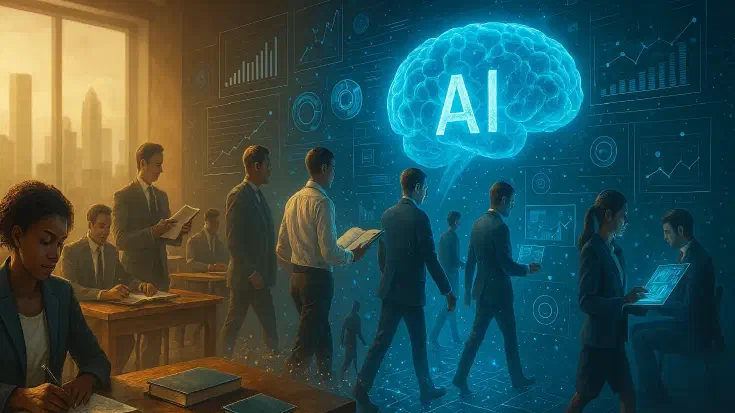
Over five decades, five technology revolutions each transformed organisations, but none restructured the essence of work itself. AI does — remaking how organisations think, decide, create, and deliver. The gap between bolting AI onto existing processes and redesigning how work is structured is already producing four times higher total shareholder returns for those who commit. This article defines what the essence of work actually is, why AI is remaking all four dimensions at different speeds, and why The Great Remaking is a race with compounding consequences that late movers cannot close through incremental catch-up.
Llantwit Major |
Published in
AI
and
Board
| 8 minute read |
In June 2024, I proposed that organisations would need to compensate workers whose expertise became embedded in corporate AI models. The rise of personal AI agents inverts that assumption entirely: individuals are already investing thousands annually in always-on agents that encode their professional judgement, domain expertise, and decision-making patterns — capability that belongs to them, not their employer. This article explores what happens when the most valuable AI in your organisation walks in with the employee and walks out when they leave, and why the IP boundaries, contractual frameworks, and talent strategies needed to navigate this shift don’t yet exist.
Llantwit Major |
Published in
AI
and
Board
| 8 minute read |
Workers with genuine AI capabilities command premiums of 28-56%; those targeting AI-exposed roles without substantive skill development face a 29% earnings penalty. The same roles, opposite outcomes, and the difference lies in the quality of capability investment, not access to tools. This article examines why this bifurcation extends to the Boardroom itself, where the IoD now positions AI competence as a core NED responsibility. For Boards, the strategic question becomes: is your workforce developing verification and judgement, or just collecting certifications — and can you tell the difference?
Llantwit Major |
Published in
AI
and
Board
| 9 minute read |
AI’s primary value isn’t replacing people, it’s releasing the intellectual capital trapped in undifferentiated work. Yet in many Boardrooms, workforce reduction remains the default success metric for AI initiatives. This article makes the case for the redeployment dividend: redirecting freed human capacity toward outcome-impacting work, complex judgement, and innovation that AI cannot replicate. For Boards, the strategic question shifts from “how many roles disappear?” to “what valuable work aren’t we doing because our best people are buried in tasks they don’t need to do?”
Llantwit Major |
Published in
AI
,
Board
and
Emerging
| 10 minute read |
World models mark AI’s shift toward true predictive power, allowing systems to simulate future scenarios and help businesses move from reacting to events to anticipating them. Drawing on emerging research, including Yann LeCun’s work on simulation-based intelligence, this article highlights the practical gains industries like aviation and finance are seeing in operational efficiency through these future-looking tools. For Boards, world models present a tantalising future: the opportunity to turn future insight into present advantage.
Llantwit Major |
Published in
AI
and
Board
| 17 minute read |
Agentic AI has become this year’s poster child, dethroning generative AI as the technology everyone wants to discuss. Yet fundamental misunderstandings about what agentic systems actually do create barriers to successful adoption. This article demystifies the hype by revealing the core truth: agentic AI is generative AI in a loop, where the machine drives iteration instead of a human, making the strategic question not about technology sophistication but where to consciously transfer decision-making agency from people to systems, and at what scale.
London |
Published in
AI
and
Board
| 15 minute read |
As I discussed in my article on building and managing AI-capable teams, organisations face a critical challenge in acquiring the right talent for AI transformation. This reminds me of the early days of cloud adoption, when I advised enterprises on their migration strategies. Back then, I witnessed the same scramble for scarce talent, which led me to advocate strongly for upskilling existing teams rather than relying solely on external hiring.
Washington D.C. |
Published in
AI
and
Board
| 10 minute read |
In the wake of the meteoric rise of generative AI, it’s easy to get swept up in the hype and believe that this single branch of artificial intelligence (AI) is the whole story. Platforms like ChatGPT have undeniably captured the public imagination, marking the first mass consumerisation of AI technology. However, focusing solely on generative AI risks overshadowing the diverse and equally transformative types of AI that have been quietly but powerfully driving business innovation.