#board-governance
How Boards direct, oversee, and stay accountable as AI lands.
Tagged articles (75)

The Great Remaking: How the Four Dimensions of Work Are Transforming
AI is remaking thinking, deciding, creating and delivering at different speeds and towards different ends. Treating them as one question is most organisations' mistake.

MCP Explained: The Agent Infrastructure Standard Boards Need to Understand
An agent that sees only the public internet is an expensive search engine. MCP connects agents to the proprietary systems that constitute advantage.

The Personal Agent Economy: When Your Best AI Isn't On Your Balance Sheet
Individuals now own AI agents that encode their judgement and expertise, capability that belongs to them rather than their employer. The assumption has inverted.

The Inference Migration: What Consumer Agents Mean for Enterprise AI's Next Phase
Consumers are already paying for always-on AI agents. That consumer-to-enterprise pipeline is the one ChatGPT ran, and it is running again.

The Invisible Asset: Why Boards Should Govern Data Like It's on the Balance Sheet
Boards steward physical assets with condition checks and ownership, and govern data as if it did not exist. The gap is governance, not technology.

The Verification Premium: What Classical Training Reveals About AI Coding Costs
AI coding tools amplify the expertise gap rather than closing it: senior developers capture twice the gains. The verification premium is the cost nobody budgets.

The AI Talent Bifurcation: Are You Building Skills or Collecting Credentials?
Workers with real AI capability command premiums of 28-56%; those collecting credentials without it face a 29% penalty. The same split now reaches the Boardroom.

The Redeployment Dividend: Why AI Will Unleash Your People, Not Replace Them
AI's primary value is not headcount reduction but the intellectual capital it releases from undifferentiated work. Measure only the former and the dividend goes unclaimed.

Return-to-Work Briefing: Five Forces Reshaping the Board AI Agenda in 2026
Five forces shape the Board's AI agenda in 2026, led by AI embedding into the enterprise faster than it can be governed. None is distant.

The Year AI Grew Up: Five Inflections That Changed the Strategic Calculus in 2025
In 2025 Boards stopped asking what AI could do and started treating it as strategic infrastructure investment. Five connected inflections drove that shift.

The Return of Traditional AI: Organisations Are Rethinking Their LLM-First Strategies
Forty-two percent of companies abandoned most of their AI initiatives this year, often because generative AI was applied to problems traditional methods solve better.
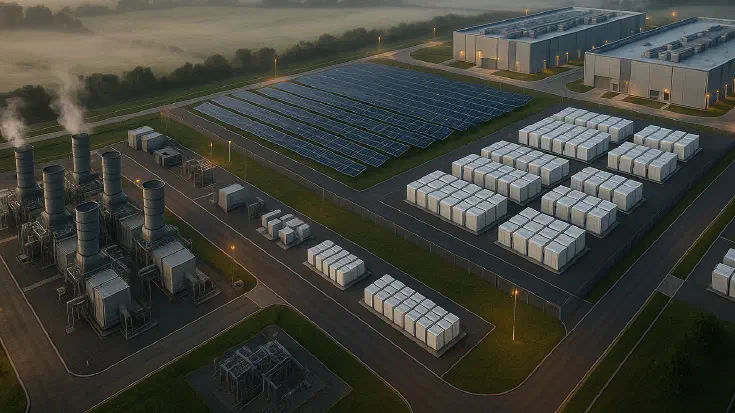
A New Grid Actor: AI Infrastructure Is Becoming Energy Infrastructure
AI infrastructure operators building their own generation become grid actors rather than consumers, and that changes energy economics, nowhere more sharply than the UK.
No articles match that filter. Clear the filter.