Cookie Consent

I use cookies to understand how my website is used. This data is collected and processed directly by me, not shared with any third parties, and helps us improve our services. See my privacy and cookie policies for more details.

Tagged with: #board-governance

Posts tagged with #board-governance present thought-leadership on structuring your governance approach to match the velocity of AI-driven decisions while maintaining robust accountability and transparency.

The Deadline Moved: What the EU AI Act Deferral Reveals About Boards

Published in Board | 10 minute read |    
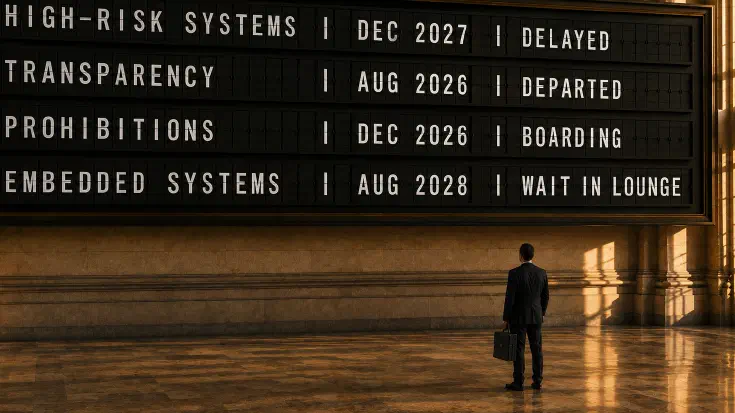
A vast split-flap departures board mounted on the marble wall of a grand institutional concourse, its four rows announcing the EU AI Act's provisions as though they were flights: high-risk systems delayed to December 2027, transparency departed on schedule in August 2026, prohibitions boarding for December 2026, and embedded systems told to wait in the lounge until August 2028, while a lone director in a dark suit stands small beneath the board with a briefcase, reading a timetable that has just changed around him, a visual rendering of the article's argument that the deferral moved some departures and not others, and that the traveller's obligations did not move at all (Image generated by ChatGPT 5.6)

On 2 August 2026, the EU AI Act’s rules for standalone high-risk systems were supposed to take effect. They will not. Six days before the deadline, the EU brought an amendment into force deferring those obligations to December 2027, because the standards and implementation machinery needed to make them workable were not ready. In this article, I set out what the deferral reveals about Boards which anchored AI governance to regulatory deadlines, and where the accountability that never moved actually sits.


The Balancing Item: The AI Oversight Cost Your Business Case Never Priced

Published in AI | 10 minute read |    
A modern open-plan office swallowed by dense fog, where a lone figure sits upright at a desk in the right of the frame, still working, his screens of charts and messages crisp at arm's length while the desks, monitors, and lamps of colleagues dissolve into white haze behind him, a visual rendering of the mental fog the research describes, where the person supervising the machine's output keeps working as clarity recedes, and the cost no business case recorded is paid in human attention (Image generated by ChatGPT 5.6)

Every AI business case counts the hours saved. Almost none counts the hours added: the reviewing, correcting, and supervising that AI outputs demand before anyone can rely on them. That oversight labour is real, regulation increasingly mandates it, and people absorb it silently on top of existing roles. BCG research published in March 2026 shows the consequence: a distinct mental fatigue attaching to heavy AI oversight loads, while workers using AI only to replace routine work report less burnout, not more. I argue this fatigue is a control cost Boards must price, and the remedy is governance, not resilience training.


Governing the Redeployment Dividend: Turning Saved Hours Into Value

Published in AI | 10 minute read |    
A Victorian mill race at dusk seen from the bank, where a broad channel of water pours over a timber weir and is lost in spray and mist lit cold blue among the reeds, while on the right a single well-fitted sluice gate, warm in the light of a lantern hung beside it, directs a narrow measured stream onto the blades of a wooden waterwheel that turns steadily below the lit window of a stone mill workshop, a visual reframe of the Redeployment Dividend, where capacity released by machines is either governed into productive work or drains silently away (Image generated by ChatGPT 5.6)

In the Redeployment Dividend I argued that AI’s real prize is releasing intellectual capital from undifferentiated work, not cutting headcount. The evidence has now caught up with the argument, and it is uncomfortable. Teams that deploy AI save the equivalent of five hours per person per week, yet most of that time drains into low-value work, and nine in ten executives report no measurable productivity impact at their own firm. The saving is real; the value is not arriving. In this article, I argue that the dividend leaks because nobody owns it. AI owns execution and managers own the workflow, but unless the Board owns whether freed capacity creates value, the hours AI recovers will simply refill with the work that was already there.


AI and the CEO: Choosing the Bets That Matter

Llantwit Major | Published in Board | 12 minute read |    
A corner executive office in dark mahogany panelling at night, lit warm on the left by a stained-glass Tiffany lamp beside a porcelain teapot and cup, where a spread of closed leather dossiers fans across a polished desk and one is squared up in the lamplight before an empty high-backed leather chair with a fountain pen resting on it as the chosen bet, the rest angled away into shadow, and cool blue light falls from floor-to-ceiling windows onto a night city skyline and waterfront beyond, a visual reframe of the few bets a chief executive draws from many and answers for, where a machine can lay out the options but only a human can choose (Image generated by ChatGPT 5.5)

The market now treats visible AI adoption as proof a company is driving forward through innovation, and the chief executive is the one expected to show it. Being seen to adopt, not misleading the market, and choosing well are three demands held at once. In this article, I argue that AI does not rewrite the chief executive’s duties; it changes the conditions under which they are discharged. The task is to choose the few bets that matter, change how the company works around them, and answer for them without delegating the accountability.


The AI Sovereignty Trilemma: When a Frontier Model Vanishes and Reality Bites

Llantwit Major | Published in AI | 10 minute read |    
A human hand pressed flat against a dark glass barrier at night, reaching toward an illuminated toggle switch mounted in a glass housing on the far side of the glass, out of reach, with a warm-lit city skyline glowing across water beyond, a visual reframe of a control that is visible but held elsewhere, behind a barrier the hand cannot cross (Image generated by ChatGPT 5.4)

Every position in the AI Sovereignty Trilemma carries a cost, but only one is shown to a Board before it is paid. The visible cost is that sovereign capability is dearer, which is where most sovereignty conversations stop. The hidden cost belongs to the convenient alternative, frontier capability bought cheaply and governed elsewhere, and it stayed invisible only because the control it surrenders had never been tested. On 12 June a directive tested it, forcing a provider to withdraw two frontier models from every customer overnight. In this article, I argue that model availability is a continuity risk a Board must own, and that the task is not to solve the Trilemma but to know which cost the organisation is paying, and to have chosen it.


AI and the CFO: Standing Behind the Numbers the Machine Produces

Seattle | Published in Board | 12 minute read |    
A CFO's desk at night in a dark wood-panelled office, lit warm on the left by a brass desk lamp where bound financial statements lie open with a fountain pen resting on a freshly signed final page, beside a crystal glass and a leather folder, and cool blue on the right through a floor-to-ceiling window onto a screen-filled finance operations floor, with an empty leather chair between them, a visual reframe of numbers a machine produces but a human still signs (Image generated by ChatGPT 5.4)

The case for AI in the finance function is no longer in question. Commitment to it now runs well ahead of readiness, but accountability does not wait for that gap to close. The CFO answers for the integrity of the accounts and the stewardship of capital every reporting cycle, ready or not, and AI is already inside the work that produces both. In this article, I argue that AI changes how each of the CFO’s duties is carried out, not who signs for them, and I sort its effect into four groups: where it does the work, where it sharpens the judgement, where it operates out of sight, and where it changes almost nothing.


Ontologies and Knowledge Graphs: Why Structure is the Next Data Frontier

Seattle | Published in Data | 15 minute read |    
An open leather-bound accounting ledger on a dark polished desk in warm lamplight, its hand-ruled columns of figures dissolving at the right-hand edge into a glowing blue three-dimensional network of connected nodes that hovers above the desk surface, a visual reframe of the same information shifting from a flat record to be read into an explicit structure that can be traversed and reasoned over (Image generated by ChatGPT 5.4)

The strategic value of data is no longer in question. The next frontier is data whose meaning and relationships are explicit enough for machines to reason over rather than merely retrieve. Unstructured information must be interpreted by whoever consumes it, whether that is a person reading a report or an AI system generating an answer. Structured information makes explicit the relationships required for traceability, verification, and defensible reasoning at scale. In this article, I argue that ontologies and the knowledge graphs built upon them have moved from technical infrastructure into Board territory, because they increasingly determine what an organisation officially knows, what its AI systems can work with, and where durable advantage is created.


The Reasoning Gap: The Capability the Law Now Demands of Boards

London | Published in AI and Board | 11 minute read |    
A polished walnut boardroom table photographed at eye level, with a tan folder embossed 'System Approved' resting flat on the left and a white envelope marked 'Notice of Contest' standing upright in a brass holder on the right. Empty leather chairs line the far side of the table; cold morning light falls through tall windows behind, illuminating the envelope sharply (Image generated by ChatGPT 5)

The UK regime now requires four safeguards for any significant decision taken solely by automated processing: information, representations, human intervention, contestability. On the page these are procedural rights. In practice they all depend on something the law does not name: whether the organisation can interrogate its own decisions well enough for the safeguards to work. For a rule-based system, that capability is built in. For a probabilistic system, it is not, and most Boards have approved those systems without ever asking whether it exists. The first contestability request is when the gap surfaces.


AI and the Chair: Governing the Board Through The Great Remaking

Llantwit Major | Published in Board | 14 minute read |    
A long boardroom table running through two contrasting zones — a warm, lamp-lit traditional boardroom on one side and a cool, glass-walled view onto an operational technology environment on the other — with a single empty chair at the head positioned exactly at the seam, symbolising the chair's position between the Board's own work and the work the Board governs as both are remade by AI (Image generated by ChatGPT 5.4)

The chair’s role was built for a stable world that no longer exists. The Board’s own work is being remade by AI tools that silently invite the substitution of director judgement, and the work the Board governs is being remade by operational AI deployments most directors cannot interrogate. This article works through how Cadbury, the FRC, and the IoD have set out chair responsibilities, none dispensable, all now requiring different execution. The principle that does not move is collective responsibility. The chair polices its boundary, actively, in both states.


Maximum Fidelity: How Four Indicator Types Strengthen Board Decisions

New York | Published in Board | 13 minute read |    
A close-up photograph of a professional audio mastering console, showing a warmly lit analogue VU meter on the left with its amber-glowing face, flanked by precision control knobs and monitoring switches on a dark panel. The shallow depth of field draws the eye to the meter itself, with the surrounding controls falling gently into shadow. An image representing the precision instruments used by audio engineers to measure fidelity, used here as a metaphor for the four indicator types that give Boards maximum fidelity on the decisions in front of them (Image generated by ChatGPT 5.4)

Boards have always governed under incomplete information. What the four indicator types offer is not more information but a progressively higher quality of it. Lagging indicators establish what happened, leading indicators signal direction, predictive indicators model possible futures, and reasoned indicators prove what is certain. Applied in combination to a single decision, they represent maximum fidelity — everything knowable and made available before the judgement is made. This article explains why the distinction between a decision made with maximum fidelity and one made without it matters for every director around the table.