#ai-compliance
Regulation, codes and obligations, and what they require of a Board.
Tagged articles (14)
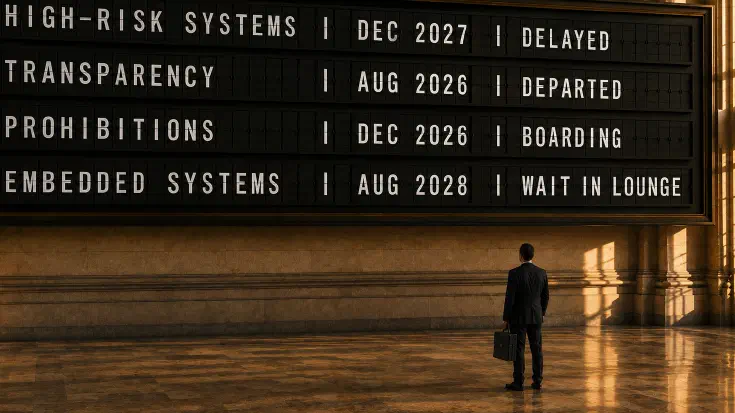
The Deadline Moved: What the EU AI Act Deferral Reveals About Boards
The EU deferred its AI Act high-risk obligations six days before they applied. What a moving deadline reveals about where Board governance is anchored.

The AI Sovereignty Trilemma: When a Frontier Model Vanishes and Reality Bites
The visible cost of sovereignty deters Boards. The hidden cost of the convenient alternative was never shown, and that is the cost 12 June presented.

AI and the Company Secretary: Operating the Boundary the Chair Polices
Board packs, agendas, and minutes now reach directors composed by systems the secretary cannot fully interrogate. The chair polices the boundary; the secretary operates it.

Ethical AI: When the Model Imposes Values Your Organisation Did Not Choose
A foundation model arrives with a value system its provider built and the Board did not choose. The decision: accept it, reject it, or build.

The Reasoning Gap: The Capability the Law Now Demands of Boards
UK law now requires four safeguards for solely automated decisions. Most Boards have approved probabilistic systems that cannot deliver them in operation.

From Probable to Provable: What Automated Reasoning Means for the Board
Automated reasoning gives Boards access to proof, not probability. This article explains what it is, where it already operates, and why it changes governance.

The Year AI Grew Up: Five Inflections That Changed the Strategic Calculus in 2025
In 2025 Boards stopped asking what AI could do and started treating it as strategic infrastructure investment. Five connected inflections drove that shift.

Minimum Lovable Governance: The AI Operating Principle Boards Should Use
Minimum lovable governance replaces episodic compliance with continuous, embedded oversight people actually want to use: guardrails that earn adoption rather than enforce it.

Shadow AI and the Case for an AI Amnesty
Shadow AI is surging and most employees would use AI tools without permission. An AI amnesty turns that hidden risk into governed, employee-validated innovation.

AI Sovereignty: A Board's Guide to Navigating Conflicting National Agendas
AI governance is fragmenting into incompatible systems: Europe's transparency, America's scale, China's control. Boards can no longer serve all three; they have to choose.

Why Boards Need to Watch the EU's General-Purpose AI Code of Practice
The EU's General-Purpose AI Code of Practice marks regulatory divergence: Europe sets transparency guardrails while America deregulates. Boards must now choose between transparency and speed.

Beyond Regulatory Uncertainty: Thoughts on the UK's AI Sovereignty Challenge
Individual AI training clusters will soon need more electricity than whole nations generate. The UK's AI sovereignty ambition meets its energy reality.
No articles match that filter. Clear the filter.