What I write about
Emerging Technology
My work on emerging technologies that could change the choices available to organisations, while being honest about how little is settled.
My take
I am comfortable being provisional about emerging technology because that is what the evidence usually requires. The timelines are unreliable, the path to adoption is unclear, and some promising ideas will remain interesting rather than consequential. The useful work is not pretending otherwise. It is deciding which developments deserve a place in the organisation’s field of view, and what would change if they mature.
I don’t think a Board needs a position on every new technology. It does need a way to distinguish a new capability from a new label, and to recognise the point at which waiting for certainty would leave too little room to act. A watching brief earns its place when it names the assumptions, the decisions that might move, and the evidence that would trigger a closer look.
My Remake framework is built for technologies that change the essence of work, not for AI alone. Quantum and embodied AI are the next tests I expect it to meet. The work gathered here follows those and other technologies while the picture is still forming, asking what they could change before trying to predict when they will mature.
Latest writing (12)

Ontologies and Knowledge Graphs: Why Structure is the Next Data Frontier
Quality tells the organisation whether data is reliable. Structure tells the machine what it means, and structure is where durable AI advantage is now decided.

From Probable to Provable: What Automated Reasoning Means for the Board
Automated reasoning gives Boards access to proof, not probability. This article explains what it is, where it already operates, and why it changes governance.

MCP Explained: The Agent Infrastructure Standard Boards Need to Understand
An agent that sees only the public internet is an expensive search engine. MCP connects agents to the proprietary systems that constitute advantage.

The Personal Agent Economy: When Your Best AI Isn't On Your Balance Sheet
Individuals now own AI agents that encode their judgement and expertise, capability that belongs to them rather than their employer. The assumption has inverted.

The Inference Migration: What Consumer Agents Mean for Enterprise AI's Next Phase
Consumers are already paying for always-on AI agents. That consumer-to-enterprise pipeline is the one ChatGPT ran, and it is running again.

Return-to-Work Briefing: Five Forces Reshaping the Board AI Agenda in 2026
Five forces shape the Board's AI agenda in 2026, led by AI embedding into the enterprise faster than it can be governed. None is distant.
The Year AI Grew Up: Five Inflections That Changed the Strategic Calculus in 2025
In 2025 Boards stopped asking what AI could do and started treating it as strategic infrastructure investment. Five connected inflections drove that shift.

World Models: The Next Horizon in AI for Predictive Enterprise Intelligence
World models move AI from reacting to anticipating: systems that simulate future scenarios, with aviation and finance already seeing the operational gains.

The Compound Loop: Why Agentic AI's Real Power Lies Beyond Generative AI
Agentic AI is more than generative AI in a loop. Compound loops coordinating several AI disciplines are where returns stop being linear.

Agentic AI: Strip Away the Hype and Understand the Real Strategic Choice
Agentic AI is this year's poster child, and most of the confusion is about what agents actually do. The Board's decision is strategic, not technical.

How Agentic AI Turns Your Biggest Tech Problem into Competitive Advantage
The legacy estate that constrains agentic AI is also its largest opportunity. Retiring technical debt is what clears the path for autonomous systems.

AI Centre of Excellence: Future-proofing Through Continuous Evolution
The AI landscape moves faster than any governance framework. An AI Centre of Excellence stays relevant only if continuous evolution is designed in.
No articles match that filter. Clear the filter.
The ideas that underpin my writing
Ideas I’ve named and matured writing about Emerging: what each one means, and where it started.
Chart of Entities
The governed set of core entity definitions that, like a chart of accounts, determines what every AI system in the organisation treats as true.
Compound Loop
An agentic system that coordinates several AI disciplines running in parallel within a single loop, so their interaction effects multiply value and governance happens once at the coordination layer rather than per technology.
Innovation Ratchets
Structural mechanisms, such as escalating success metrics and mandatory talent rotation, that make backward movement difficult and keep an AI CoE focused on innovation rather than drifting into administration.
Board Briefings
For directors who want to go deeper, my Board Briefings bring the related writing, evidence, and practical questions together in one place.

The Great Remaking
How AI is transforming the very essence of work

AI Transformation
Crossing from pilots to enterprise-scale change

AI & the Workforce
Talent, skills, and the people side of adoption

AI Risk
Seeing and pricing the risks AI actually creates
The Board in the Machine
Signals
My early reads on technologies that may matter to Boards, published while the evidence is still forming and the strategic implications remain open.
Quantum Computing
Quantum error correction has crossed important experimental thresholds. The Board question is how to time readiness against evidence, not vendor roadmaps alone.
Automated Reasoning
Formal logic and mathematical proof, industrialised. For some precisely specified, high-consequence controls, testing is no longer the strongest assurance available.
Embodied AI
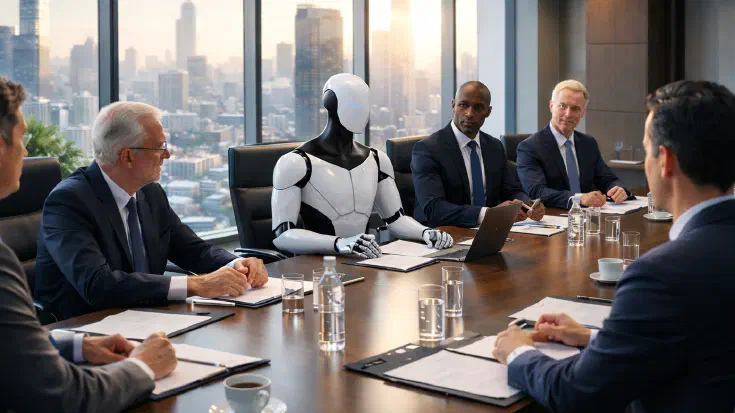
AI that acts in the physical world, from factory humanoids to autonomous machines. The liability, capital, and workforce questions are already Board-level.
Questions Boards ask about Emerging Technology
Are the assurances the organisation provides its Board based on probability, or proof?
Board assurance often rests on testing, sampling, and statistical confidence. The useful test is whether an assurance covers the complete, formally specified population or only the cases examined. Where a Board-approved constraint has been encoded and exhaustively verified, the answer is proof. Elsewhere it remains probability, however polished the presentation.
How do we audit decisions made by swarms of interacting agents?
Traditional audit expects an identifiable decision-maker, a decision point, and a traceable rationale. Interacting agents can blur all three. The audit capability therefore has to be designed into the system through bounded authority, interaction and decision logs, and escalation triggers tied to anomalous outcomes. Once the swarm is operating, an audit layer added afterwards cannot reconstruct evidence that was never recorded.
When an employee trains a personal agent on the job, whose intellectual property is it?
The boundary has never been clean, but personal agents make it operational. Judgement and expertise developed at work can be encoded in a system that is reusable, portable, and capable of being refined elsewhere. A credible answer covers the model and data used, the organisation’s employment and assignment terms, what may leave with the individual, and what uses remain permitted afterwards. Contracts written for documents and inventions may not settle the position on their own.
Who is liable when embodied AI operating in physical space causes unintended harm?
Liability does not move to the machine. Before deployment, the organisation needs a clear account of which decisions the system may make in physical space, where human intervention remains available, what legal duties and insurance cover apply, and who owns the consequence. The Board does not need to perform the legal analysis itself, but it should require that the answer exists before an incident forces the question.
Does Remake apply beyond AI?
Yes. Remake is designed for technologies that change the essence of work, not for AI alone. AI is the first instance, and quantum and embodied AI are the next tests I expect it to meet. Other technologies belong in scope only if they pass the same test. The technology may change, but the framework’s questions do not: what work changes, who has agency, who remains accountable, and how the change is carried through.