What I write about
The Cloud
My work on what organisations choose to own, what they choose to rent, and what they are prepared to depend on.
My take
Cloud sits in the middle of my career arc. I came to it as a founder, after building for the web and ecommerce, and re-engineered my own platform before moving more than 400 clients to the cloud. That taught me that the migration is usually the most visible part and rarely the most consequential. The lasting choices sit in the economics and operating model that follow: what the organisation commits to, which capabilities it chooses not to own, and how much freedom it retains to change course.
I don’t think there is one correct cloud posture. Some workloads justify deep commitment because the economics and capability are compelling. Others need portability, sovereign control, or a credible route out. That is why I treat cloud financial management as an operating discipline, not a procurement exercise revived when a contract comes up for renewal.
The question I keep coming back to is whether the organisation still understands the trade it has made. Cloud can replace fixed infrastructure with on-demand capability and give an organisation room to move, but the trade now reaches far beyond the monthly bill, into commitments, concentration, sovereignty, energy, and technical debt. The work gathered here follows those choices from the first migration business case to the infrastructure an organisation ultimately depends on.
Latest writing (29)

The AI Sovereignty Trilemma: When a Frontier Model Vanishes and Reality Bites
The visible cost of sovereignty deters Boards. The hidden cost of the convenient alternative was never shown, and that is the cost 12 June presented.

The Headroom Argument: Why AI Efficiency Means More Compute, Not Less
Architectural efficiency expands AI compute demand rather than reducing it. Three forces converge on more inference. Boards should read efficiency news as capability, not cost.

The Inference Migration: What Consumer Agents Mean for Enterprise AI's Next Phase
Consumers are already paying for always-on AI agents. That consumer-to-enterprise pipeline is the one ChatGPT ran, and it is running again.

The Year AI Grew Up: Five Inflections That Changed the Strategic Calculus in 2025
In 2025 Boards stopped asking what AI could do and started treating it as strategic infrastructure investment. Five connected inflections drove that shift.

A New Grid Actor: AI Infrastructure Is Becoming Energy Infrastructure
AI infrastructure operators building their own generation become grid actors rather than consumers, and that changes energy economics, nowhere more sharply than the UK.

UK AI Energy Constraints: From Niche Concern to Investment Banking Focus
When Goldman Sachs says power, not capital, is AI's bottleneck, energy stops being a niche concern. UK Boards pay four times their competitors' energy costs.

AI Sovereignty: A Board's Guide to Navigating Conflicting National Agendas
AI governance is fragmenting into incompatible systems: Europe's transparency, America's scale, China's control. Boards can no longer serve all three; they have to choose.

How Agentic AI Turns Your Biggest Tech Problem into Competitive Advantage
The legacy estate that constrains agentic AI is also its largest opportunity. Retiring technical debt is what clears the path for autonomous systems.

Beyond Regulatory Uncertainty: Thoughts on the UK's AI Sovereignty Challenge
Individual AI training clusters will soon need more electricity than whole nations generate. The UK's AI sovereignty ambition meets its energy reality.

Rethinking Business Cases in the Age of AI: What Boards Need to Know
Traditional business case methods assume sequential adoption. AI runs in parallel across maturity stages at once, and the valuation has to change with it.
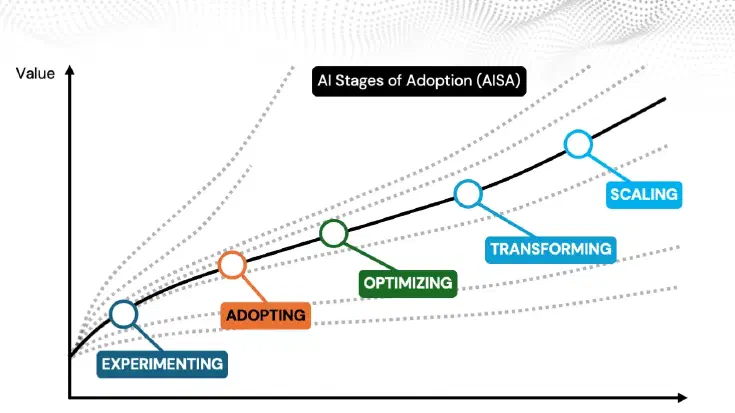
Understanding the AI Stages of Adoption: A framework for business leaders
The AI Stages of Adoption locate an organisation, function by function, on a five-stage path from Experimenting to Scaling, and show how to move.

The future of AI expertise: Building and managing AI-capable teams
AI's promise of productivity and innovation is delivered by teams, not tools. Building AI-capable teams draws on what the Cloud Centre of Excellence taught me.
No articles match that filter. Clear the filter.
The ideas that underpin my writing
Ideas I’ve named and matured writing about Cloud: what each one means, and where it started.
Adaptive Localisation
A strategy of running different AI approaches in different markets, tuned to each market's regulatory, cultural, or competitive conditions, deliberately trading consistency for regional advantage. For a Board, choosing this stance means accepting real complexity costs and being ready to answer why the organisation treats one market's rules differently to another's.
AI Skills Paradox
AI simultaneously threatens to automate certain roles while creating acute talent shortages in others, requiring organisations to prepare workers for both displacement and new opportunities at once.
Cultural Sovereignty
The often-overlooked dimension where American, European and Chinese AI cultures embody different worldviews, disruption, deliberation and harmony, shaping architecture, governance and stakeholder engagement beyond regulation.
Board Briefings
For directors who want to go deeper, my Board Briefings bring the related writing, evidence, and practical questions together in one place.

AI Infrastructure
Compute, energy, and the plumbing beneath enterprise AI

AI Risk
Seeing and pricing the risks AI actually creates

Operating AI
Building the Centre of Excellence that scales adoption

AI Business Cases
Investment cases that survive contact with the Board
The Board in the Machine
Signals
My early reads on infrastructure and technologies that are changing what organisations can build, buy, and depend on, while the picture is still forming.
Post-Quantum Cryptography
Quantum-resistant cryptography standards are published and migration targets set. Data stolen today may be decrypted later, which makes the transition a Board question now.
Quantum Computing
Quantum error correction has crossed important experimental thresholds. The Board question is how to time readiness against evidence, not vendor roadmaps alone.
Agentic AI
Generative models are being given goals, tools, and the authority to act. The Board question is where to transfer agency, and under what limits.
Questions Boards ask about The Cloud
How do we tell whether moving an application to the cloud makes sense?
By pricing the whole journey, not the destination: alongside run-cost comparisons, the assessment must include the migration bubble (the temporary double-running of old and new), the decommissioning cost of what you leave, and the resource plan for the people who carry the move. TCO models that stop at the target-state bill systematically flatter the case; that discipline became the Cloud Business Case vocabulary.
Is technical debt putting a ceiling on our AI ambitions?
Agents are only as capable as the systems they can reach: decades-old data lineage, undocumented logic layers, and brittle integrations cap what any agentic deployment can safely do. If the honest audit shows agents working around the estate rather than through it, the debt is the strategy constraint, and no amount of model capability buys past it.
What hybrid hosting strategies could balance cost, compliance, and control?
For most organisations, the practical answer is workload-tiered placement: sovereignty-critical systems in environments that meet their residency, operational-control, and continuity requirements, and cost-sensitive workloads where the economics run best. The design work is in the classification, and in keeping the boundary movable as those requirements change.
How do we quantify the true cost of AI sovereignty versus dependency?
The comparison has to price more than compute: energy, any premium for stronger sovereignty controls, and the legal, continuity, and long-term commercial exposure created by infrastructure governed elsewhere all belong in the same model. The comparison is incomplete until both the visible premium and the dependency exposure are on the page.
Should we own our compute or rent it, and can we secure the energy?
Securing a long-term energy contract can reduce price volatility, but it does not by itself secure grid access, planning approval, or resilience, and it does not ensure the compute remains useful for as long as the contract runs. Direct ownership makes sense where demand is large and predictable, control or sovereignty is material, and the organisation can keep expensive capacity well used. Cloud makes more sense where demand is variable, access to changing capability matters, or flexibility is worth more than ownership. The practical answer may be a portfolio: own the capacity whose control is strategic, and source the rest through cloud providers. The Board should be able to say which workloads belong in each category, and what trade it is making.