What I write about
The Boardroom
My work on the decisions Boards must own, the judgement they must exercise, and the accountability they cannot delegate.
My take
The Boards I meet are rarely short of information. What is harder to see is whether a decision has reached them while it is still open, or after the framing, the options, and the preferred answer have already been settled elsewhere. That is where most of my work here starts: with the conditions directors need to exercise judgement rather than ratify a conclusion.
I don’t think directors need to become technologists to govern technology well. They do need enough capability to test the case management presents, distinguish evidence from confidence, and know when agency has moved without accountability moving with it. That work reaches the whole Board: the chair protecting collective accountability, the company secretary preserving the conditions for judgement, and every director bringing a view they have formed for themselves.
The question I keep coming back to is whether the Board and the people transforming the work are looking at the same picture. My Remake framework is where I connect agency for the work with accountability for the change, from the decision to begin through to the outcome the Board must stand behind. The work gathered here follows that boundary across director capability, Board information, strategy, risk, and accountability.
Latest writing (95)

The Principle of Least Intelligence: How Much AI Does the Work Need?
Apply no more intelligence than the outcome needs: the Principle of Least Intelligence matches capability to the work, with permission to act decided separately.

Managers Own the Workflow: Where the AI Business Case Becomes Real
Most AI business cases count the time agents save; the saving becomes real, or not, in the manager's workflow, a job rarely redesigned for it.

The Supplier Grades the Customer: What Pacing the Frontier Means for the Organisations That Buy It
Access to the frontier is now something the supplier allocates, not something the customer buys. The accountability for depending on it stays with the Board.

Nothing Has to Leave the Building: The AI Risk That Is Not a Data Breach
Frontier AI may pass an organisation's know-how to a model its competitors can buy. A Board governs that by deciding which work goes in.

The Debugging Gap: The Skill Your AI Business Case Assumes You Still Have
AI now writes the code and does the debugging that taught developers to check it. Verification demand rises as the route to building it weakens.
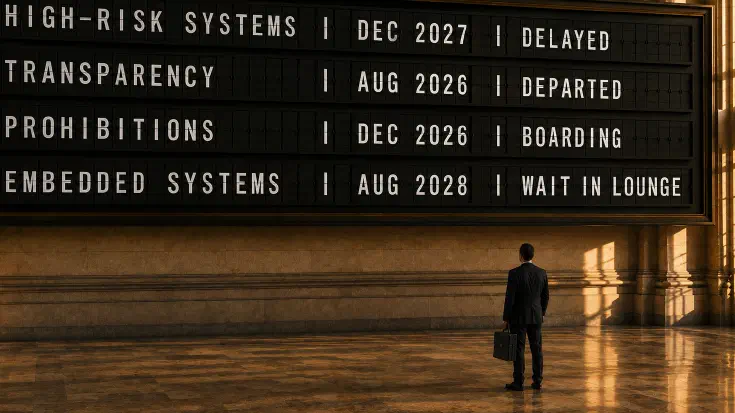
The Deadline Moved: What the EU AI Act Deferral Reveals About Boards
The EU deferred its AI Act high-risk obligations six days before they applied. What a moving deadline reveals about where Board governance is anchored.

The Balancing Item: The AI Oversight Cost Your Business Case Never Priced
Every AI business case counts the hours saved. Almost none counts the oversight hours added, and people are silently absorbing the difference.

Governing the Redeployment Dividend: Turning Saved Hours Into Value
AI is saving time almost everywhere. The organisations that gain from it are the ones whose Boards decide what the recovered capacity becomes.

Not Everything Needs AI: The Questions That Come Before the Decision
Boards keep being told to remake the business around AI. The real question is not which tool, but whether the work needs doing at all.

AI and the CEO: Choosing the Bets That Matter
AI can build, deliver, and draft, yet the chief executive still chooses and still answers. Accountability for the bets does not move.

The AI Sovereignty Trilemma: When a Frontier Model Vanishes and Reality Bites
The visible cost of sovereignty deters Boards. The hidden cost of the convenient alternative was never shown, and that is the cost 12 June presented.

AI and the CFO: Standing Behind the Numbers the Machine Produces
AI can run the close, sharpen the forecast, and operate out of sight, yet the CFO still signs. Accountability for the numbers does not move.
No articles match that filter. Clear the filter.
The ideas that underpin my writing
Ideas I’ve named and matured writing about Board: what each one means, and where it started.
Accountability Gap
When an organisation delegates work to AI without building the capability to verify it, leaving people answerable for outputs no one has actually checked. For a Board, no delegation to AI should be approved without also approving who checks the output and how, because accountability without a verification step is accountability in name only.
Adaptive Localisation
A strategy of running different AI approaches in different markets, tuned to each market's regulatory, cultural, or competitive conditions, deliberately trading consistency for regional advantage. For a Board, choosing this stance means accepting real complexity costs and being ready to answer why the organisation treats one market's rules differently to another's.
AI Capability Bifurcation
The split between workers who build genuine capability to verify and apply judgement to AI outputs, who command a premium, and those who merely accumulate credentials or tool exposure, who face an earnings penalty. For a Board, the same divide runs through the boardroom itself: familiarity with AI tools is not the same as the capability to challenge what the organisation actually does with them.
Board Briefings
For directors who want to go deeper, my Board Briefings bring the related writing, evidence, and practical questions together in one place.




The Board in the Machine
Signals
My early reads on technologies and ideas that are starting to reach the Board agenda, while the picture is still forming.
Agentic AI
Generative models are being given goals, tools, and the authority to act. The Board question is where to transfer agency, and under what limits.
Automated Reasoning
Formal logic and mathematical proof, industrialised. For some precisely specified, high-consequence controls, testing is no longer the strongest assurance available.
Embodied AI
AI that acts in the physical world, from factory humanoids to autonomous machines. The liability, capital, and workforce questions are already Board-level.
Remake
The models, diagnostics, methodologies, and principles from the Remake Library that I use when working through Board judgement, director capability, and the line between agency and accountability.
- Principle Minimum Lovable Governance Governance embedded in how work happens: proportionate to risk, continuous rather than episodic, and used because it works.
- Model Six Board Concerns An interconnected lens of six concerns, Strategic Alignment, Ethical and Legal Responsibility, Financial and Operational Impact, Risk Management, Stakeholder Confidence and Safeguarding Innovation, that must be orchestrated together so AI discussion does not collapse into risk management alone.
Questions Boards ask about The Boardroom
Can I evaluate what I am being asked to oversee?
It asks whether your oversight is real or nominal. A credible yes means you can test management’s claim of strong AI governance with a question of your own, distinguish well-governed AI from well-presented AI, and recognise a deployment drifting from its specification. If any answer is no, the development priority is clear: oversight without the capacity to evaluate is oversight in name only.
Is my view genuinely mine?
It asks where your position on AI was formed. If it is constructed entirely from management briefings you cannot interrogate, it is endorsement rather than judgement. A credible yes rests on independent information: your own resources and sources of insight on AI, per the IoD’s Recommendation 10, and knowing the strategy has changed materially before a journalist asks.
Are the assurances the organisation provides its Board based on probability, or proof?
Board assurance often rests on testing, sampling, and statistical confidence. The useful test is whether an assurance covers the complete, formally specified population or only the cases examined. Where a Board-approved constraint has been encoded and exhaustively verified, the answer is proof. Elsewhere it remains probability, however polished the presentation.
How many of our decisions are truly human, and how many are AI with sign-off?
The question probes the migration I call the change in decision architecture: nominal authority stays with people while the cognitive content of the decision shifts to the machine. Deloitte’s data shows 60% of executives now regularly use AI to support decisions while only 5% of organisations rate themselves mature in governing them, so most Boards cannot currently answer this with precision. A credible answer names the decision classes where AI recommendations dominate, and shows that accountability structures were redesigned when the decision substance moved.
What happens when nobody is accountable?
The work does not start. A remaking proceeds only where there are people with the skills and authority to do the work and accountability for the change that reaches the Board, and the gate tests both together. Accountability cannot be handed to a project team and still mean anything: a sponsor who fades after kickoff is not accountability, and a Board that is briefed but not answerable is not oversight. A change with no one truly answerable fails often enough that the framework refuses to start one.