The Great Remaking
Board Briefing

The Great Remaking

AI is restructuring how organisations think, decide, create, and deliver, and the gap between those that redesign work and those that wait compounds.

12 articles 1 video 10 audio Updated 19 July 2026

Start here

Two short reads that orient you: what The Great Remaking actually is, and the order in which to work through this briefing.

Start with this

What The Great Remaking Is, and Why It Is a Race

The claim at the centre of this briefing, the mistake I see Boards make most often about it, and the judgement a director should come away able to make.

2 minute read · Read →

Then read this

One Argument in Four Parts

The order to read this briefing in, what each section contributes, and what to do with the diagnostic once you have it.

2 minute read · Read →

Core reading

The core sequence builds one argument from claim to diagnostic; the pieces alongside follow the remaking into the workforce and the boardroom.

  1. The Great Remaking: AI and the Race to Transform the Very Essence of Work

    Five technology revolutions changed organisations; none restructured the essence of work. AI does, and redesign beats bolt-on by four times in shareholder returns.

    10 minute read · 22 February 2026

    Read the article →or listen to the podcast version → 16 minute listen

  2. The Great Remaking: How the Four Dimensions of Work Are Transforming

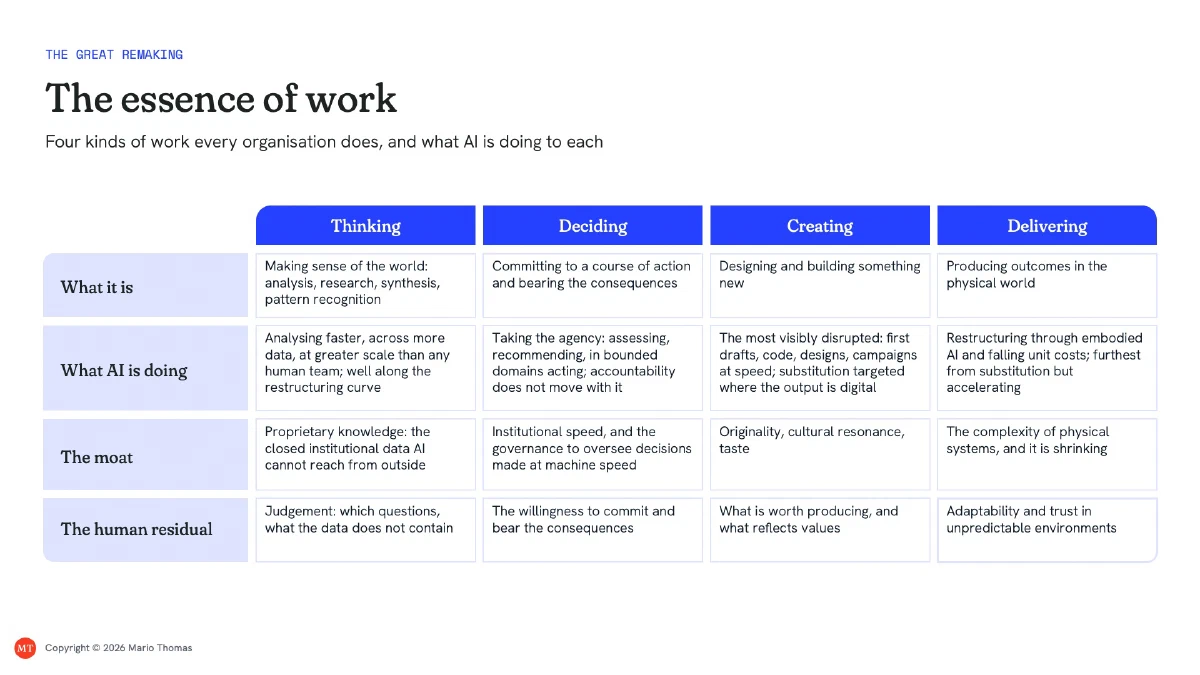
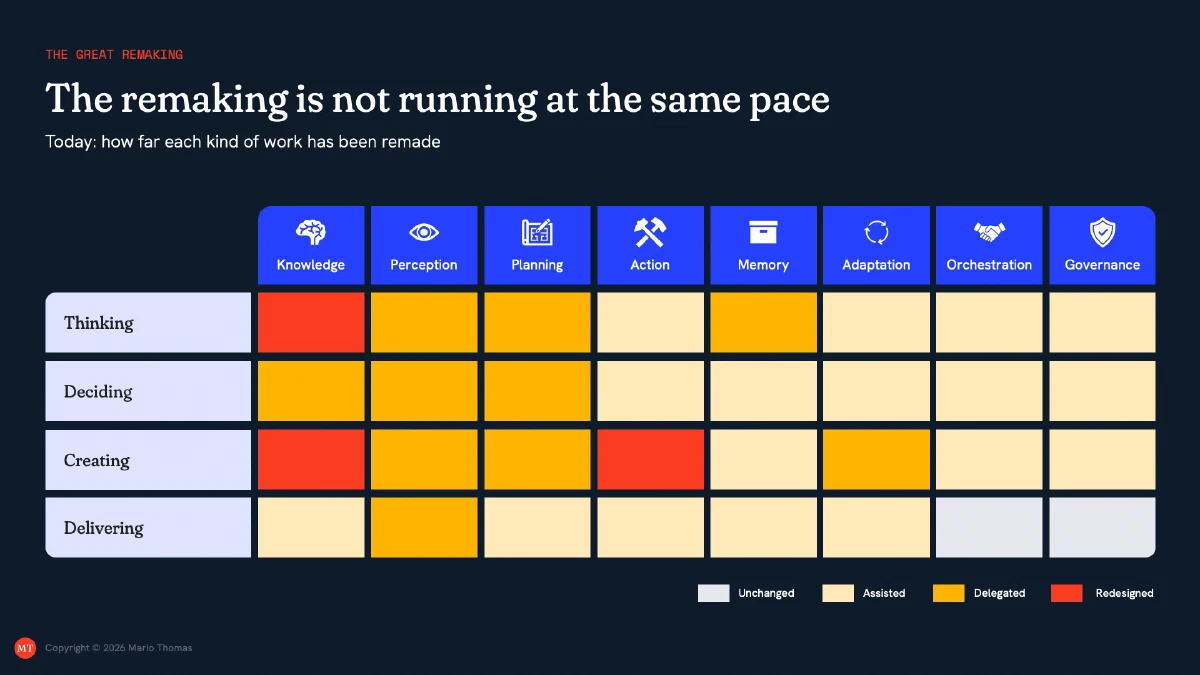
    AI is remaking thinking, deciding, creating and delivering at different speeds and towards different ends. Treating them as one question is most organisations' mistake.

    15 minute read · 8 March 2026

    Read the article →or listen to the podcast version → 20 minute listen

  3. The Great Remaking: Why Fast Following Does Not Work When the Gap Compounds

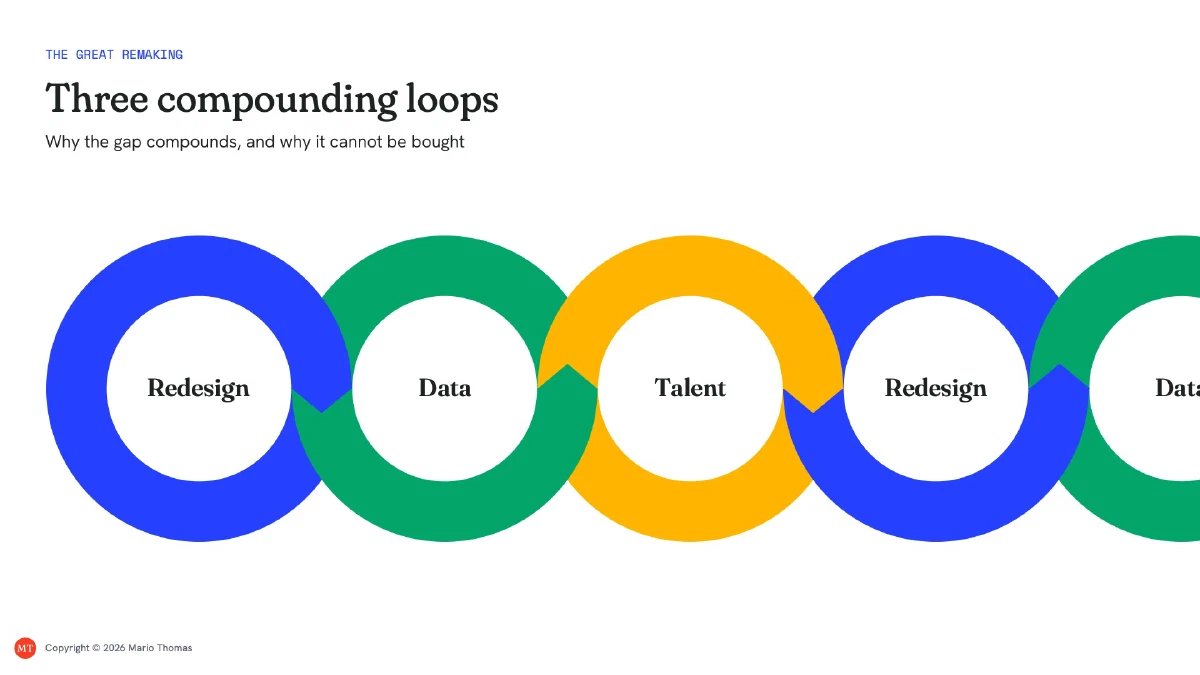
    Every previous technology wave rewarded fast followers. The Great Remaking does not: the advantage is operational accumulation that cannot be bought and compounds with time.

    13 minute read · 15 March 2026

    Read the article →or listen to the podcast version → 16 minute listen

  4. The Great Remaking: The Questions Boards Should Be Asking About Their AI Position

    Pilot counts and budget lines cannot tell a Board whether work is being remade. These questions, built on the data, talent and process loops, can.

    10 minute read · 22 March 2026

    Read the article →or listen to the podcast version → 14 minute listen

Featured Video

The Great Remaking

What AI is doing to the essence of work, why the gap between the organisations that redesign the work and those that wait compounds, and the questions a Board should ask about its own position.

Watch →

Further reading

Remake

The mechanisms beneath the thinking: the model, diagnostic, methodology, and principle from the Remake Library that turn this briefing into apparatus a Board can use.

Questions

The questions directors put to me most often about The Great Remaking, answered from the articles in this briefing.

Is AI not simply the sixth technology wave, to be managed like the previous five?

The previous five waves changed how organisations accessed, connected, distributed, and scaled, and each rewarded a measured, follow-the-leader response. None of them restructured how organisations think, decide, create, and deliver, which is precisely what AI is doing across both the cognitive and the physical domains. The Great Remaking sets out the evidence for why this is a difference in kind, not just scale, and why that changes the strategic response it demands.

Why can we not wait, watch the early movers, and follow fast?

Because the source of advantage this time is not a product that can be studied and replicated. It is operational accumulation: proprietary data shaped by AI-integrated workflows, capability developed through sustained practice, and institutional knowledge of redesign itself. BCG’s 2026 research attributes roughly 70% of AI value to redesigning the people component, which is the part no procurement decision can buy. Fast Following works through the three loops that make the gap compound rather than close.

Management reports strong AI progress. How do we test whether it is real?

Pilot counts, budget lines, and strategy documents measure activity, not compounding advantage, and self-assessments of AI maturity are systematically inflated. Ask instead whether a specific workflow has been redesigned rather than augmented in the past 18 months, what data it now generates that it did not before, and what the organisation has learned about redesign itself. The Diagnostic gives the full set of probing questions, with a guide to what credible answers look like.

Does The Great Remaking mean large-scale workforce reduction?

Not if the Board chooses otherwise. Headcount reduction is the default success metric for AI initiatives in many boardrooms, and I think it is the wrong one: the larger value lies in releasing the intellectual capital trapped in undifferentiated work and redirecting it towards work AI cannot do. The Redeployment Dividend makes that case, and Dawn of the three-hour work week asks what an equitable settlement with the workforce might look like.

Is the Board itself part of what is being remade?

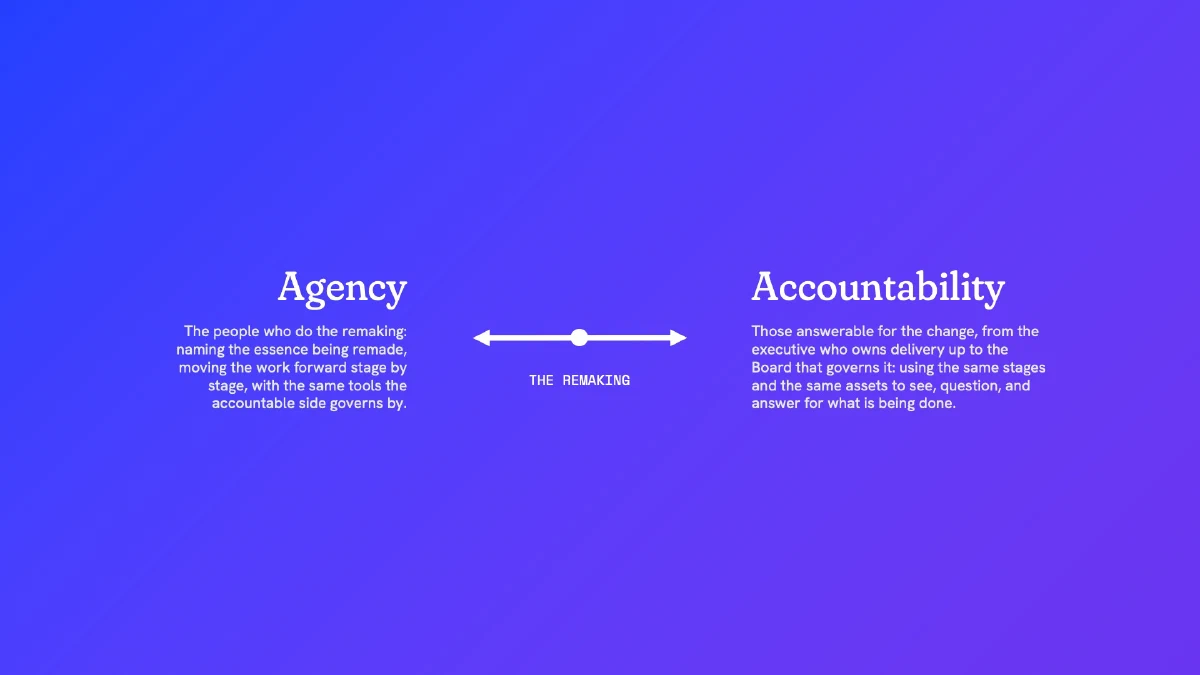
Yes, and in two states at once: AI in the preparation of board materials invites the quiet substitution of director judgement, while AI in the operations of the business produces decisions most directors cannot yet interrogate. Agency can be transferred to machines; accountability cannot, and the chair polices that boundary. AI and the Chair works through what existing chair responsibilities now require, and The Personal Agent Economy previews the ownership questions coming behind them.

How small a redesign can we start with?

One piece of work, not a programme. The three loops that make the gap compound start from a single decision: restructure one workflow around what AI can do rather than bolting AI onto it. Name the work precisely (a redesigned credit decision is a piece of work, an AI programme is not), with someone able to restructure it and someone answerable for it all the way up to the Board. The value compounds from the moment the decision is made and depreciates with every month it is deferred. Fast Following explains why, and the Process Audit diagnostic takes one process at a time from evidence to verdict.

Which of the four kinds of work is moving fastest in our sector?

That varies by sector, which is why the question matters: the four are not moving at the same speed. In most organisations I see, thinking and creating are furthest along. AI as a faster research assistant is already commoditised, and a restructured creative function runs a different ratio of human direction to machine execution. Deciding moves more carefully, because AI can take the agency in a decision but not the accountability. Delivering is furthest from substitution but accelerating as the cost of embodied AI falls, and its pace differs most by sector. Four Dimensions works through each in turn, with the human residual that survives in every case.

Does a remaking mean putting AI into everything?

No. The remaking is the mandate; putting a model into everything is fashion with a budget. Examine any single piece of work honestly and there are only three verdicts: stop it, keep it, or change it. Only the last reaches a tool decision, and a model suits judgement; it is the wrong instrument for a question with one right answer. The most valuable answer is often that the work should stop, and nobody below the Board has the standing to say so. Not Everything Needs AI sets out the three questions that come first, and the Stop Keep Change model is how the verdicts are governed.

References

The external research and primary sources the articles in this briefing draw on.

BCG

AI Transformation Is a Workforce Transformation

The February 2026 research behind the 10/20/70 value split and the four-times shareholder return gap between AI leaders and laggards.

McKinsey & Company

The State of AI

The State of AI global survey: adoption at 88% of organisations, with workflow redesign among the strongest predictors of EBIT impact.

Stanford HAI

The 2025 AI Index Report

The AI Index 2025: model performance converging and inference costs falling 280-fold, shifting advantage to what organisations build around AI.

PwC

The Fearless Future: 2025 Global AI Jobs Barometer

The 2025 Global AI Jobs Barometer: a 56% wage premium for AI skills and three times the revenue growth per employee in the most AI-exposed industries.

White House CEA

Artificial Intelligence and the Great Divergence

Artificial Intelligence and the Great Divergence: the national-level parallel to the organisational gap this briefing describes.

Deloitte

AI and the future of human decision-making

2026 Global Human Capital Trends: 60% of executives use AI to support decisions while only 5% of organisations rate their decision maturity as leading.

Harvard Business Review

Survey: How Executives Are Thinking About AI in 2026

The January 2026 executive survey: 39% of organisations with AI in production at scale, and culture named the biggest barrier by 93% of data and AI leaders.

Goldman Sachs Research

The global market for humanoid robots could reach $38 billion by 2035

Humanoid robot costs falling 40% year on year: the economics accelerating the remaking of physical delivery work.

Protiviti & BoardProspects

How Boards Drive AI ROI: 2026 Governance Survey

The 2026 Global Board Governance Survey: boards that discuss AI at every meeting correlate strongly with high AI returns.

Institute of Directors

NEDs Reimagined

NEDs Reimagined (January 2026): the Commission naming technical literacy gaps and the limits of AI judgement as challenges for directors.

BCG

The Widening AI Value Gap

The Widening AI Value Gap, 2025: the 5% of future-built organisations show 1.7 times the revenue growth and 3.6 times the three-year shareholder return of AI laggards.

BCG

AI at Work: Momentum Builds, but Gaps Remain

AI at Work 2025: 67% of people in redesigned processes report an hour a day saved against 49% in augmented ones, the pace gap the film turns on.

PwC

Three-quarters of AI’s economic gains are being captured by just 20% of companies – with the leading companies focused on growth, not just productivity

PwC’s 2026 AI Performance Study of 1,217 executives: around three quarters of AI’s economic gains captured by 20% of companies, which are twice as likely to redesign workflows.

McKinsey & Company

The State of Organizations

The State of Organizations 2026: 88% of organisations experimenting with AI and 81% reporting no meaningful bottom-line gains, the two figures the video sets against each other.

Concepts

The ideas beneath this briefing

Ideas I’ve named and matured writing about The Great Remaking: what each one means, and where it started.

The Essence of Work

The four irreducible dimensions of work every organisation performs: thinking, deciding, creating, and delivering. AI is restructuring each at a different speed along a trajectory from augmentation to substitution.

Read the article →

The Great Remaking

AI changing the essence of work rather than merely its tools: the redistribution of judgement, the bifurcation of the workforce, and what organisations owe the people whose roles are remade. The frame that lets a Board govern workforce transition as a strategic programme, not an HR afterthought.

Read the article →

Human Residual

The durable human contribution that survives in each dimension of work as AI advances: judgement in thinking, accountability in deciding, taste and originality in creating, and adaptability and trust in delivering.

Read the article →

Data Loop

A compounding cycle in which AI-integrated workflows generate higher-quality, better-structured operational data that feeds back into an organisation's AI systems, improving their performance and, in turn, producing still better data over time.

Read the article →

Process Redesign Loop

The institutional capability for redesign itself: accumulated knowledge, cross-functional relationships, and governance that make each successive restructuring of work around AI faster, compounding organisational learning capacity rather than just productivity.

Read the article →

More Board Briefings

More complete resources on AI and emerging technology for the Boards that need the full picture.

I use cookies to understand how my website is used. This data is collected and processed directly by me, not shared with any third parties, and helps me improve my website. See my privacy and cookie policies for more details.