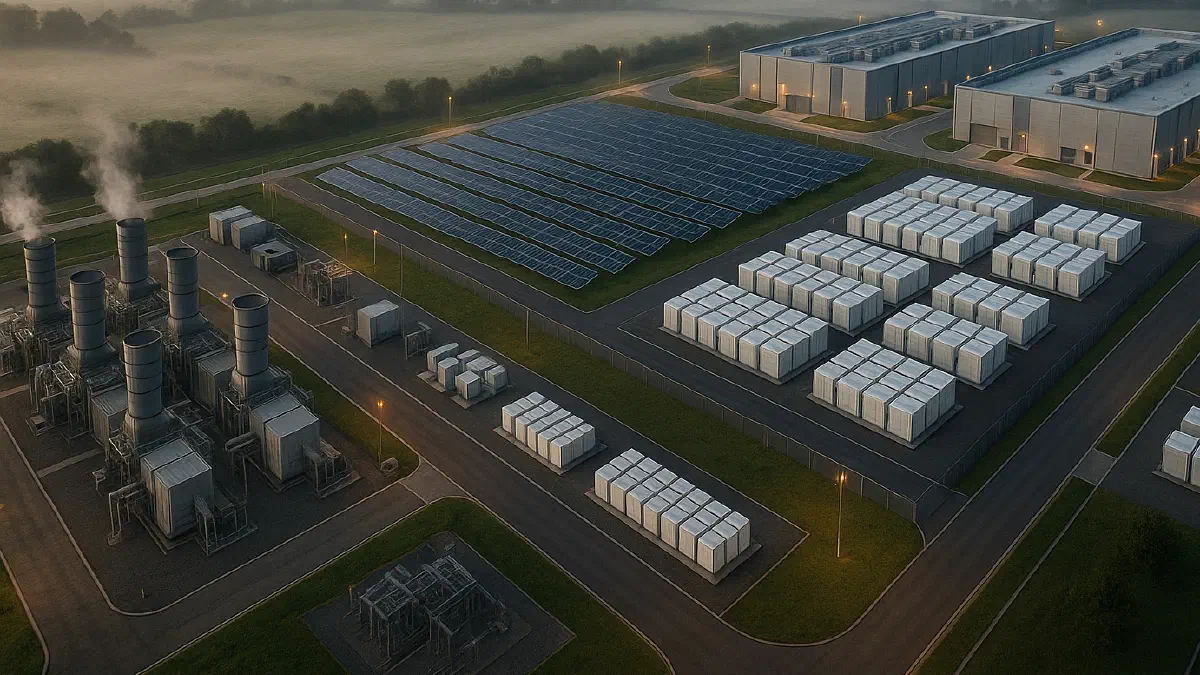
A New Grid Actor: AI Infrastructure Is Becoming Energy Infrastructure
AI infrastructure operators building their own generation become grid actors rather than consumers, and that changes energy economics, nowhere more sharply than the UK.
According to a Financial Times analysisig.ft.comThe power crunch threatening America’s AI ambitionsThe interactive analysis behind the projected 19GW US power shortfall by 2028.Published Open link , the USA faces a 19GW power shortfall by 2028, representing over 40% of projected data centre demand. Coupled with eight-year grid interconnection queues and 18-month GPU refresh cycles, this AI power crunch is forcing hyperscalers and AI labs to build their own generation capabilities. This behind-the-meter shift represents more than operational adaptation — it transforms AI infrastructure operators from energy consumers into grid actors.
The scale of the shift
The hyperscaler responseGlossaryHyperscalerA large-scale cloud and AI infrastructure operator such as Microsoft, AWS, Meta, Google or Oracle, now building gigawatt-scale generation to secure the power their compute requires. illustrates the scale of commitment required to secure this new competitive moat: xAI’s Colossus cluster operates on dozens of gas turbines, OpenAI’s Stargate facility includes 361MW of behind-the-meter generationGlossaryBehind-the-meter generationOn-site power generation built by data centre operators to serve their own load directly, bypassing multi-year grid interconnection queues; when it exceeds compute demand, surplus capacity can be exported., and Meta’s Prometheus cluster adds 200MW of on-site capacity. As I’ve explored in my previous UK AI sovereignty articles, energy access increasingly determines who wins the AI race — but when organisations build generation at this scale, a new question emerges: what happens when that moat generates surplus power?
The behind-the-meter transition is accelerating faster than most governance frameworks anticipate. Bloom Energy projectsbloomenergy.comOnsite Generation Expected to Fully Power 27% of Data Center Facilities by 2030Published Open link Archived copy that 27% of data centre facilities will be fully powered by on-site generation by 2030, up from just 13% today. Enverus research showsenverus.comDistributed generation: The turbines are comingPublished Open link Archived copy annual production of small-scale turbines and engines growing from 24GW in 2024 to 27.4GW by 2027. This surge is exemplified by Boom Supersonic’s recent launch of its Superpower turbine — a 42-megawatt natural gas unit designed for AI data centres — which has already seen inquiries exceed the company’s planned production capacity for the next five years just days after CEO Blake Scholl announced the turbines on Xx.comBlake Scholl 🛫 (@bscholl) on XPublished Open link . The IEA’s World Energy Outlook 2025iea.orgWorld Energy Outlook 2025World Energy Outlook 2025: global data centre demand rising 160% by 2030, and the SMR timeline.Published Open link confirms global data centre demand rising 160% by 2030, with the UK facing potential 20-30% electricity price increases without coherent distributed generation strategies.
The hyperscaler response has been unprecedented. Combined nuclear commitments now exceed 8GW across major providers — Microsoft securingconstellationenergy.comConstellation to Launch Crane Clean Energy Center, Restoring Jobs and Carbon-Free Power to The GridPublished Open link 835MW plus an SMR pipeline through the Three Mile Island restart, AWS committing to 1.92GW from Susquehannair.talenenergy.comTalen Energy Expands Nuclear Energy Relationship with AmazonPublished Open link Archived copy plus small modular reactor (SMR) investmentsaboutamazon.comAmazon signs agreements for innovative nuclear energy projects to address growing energy demandsPublished Open link Archived copy , Meta signing for 1.1GW with Constellation Energyconstellationenergy.comConstellation, Meta Sign 20-Year Deal for Clean, Reliable Nuclear Energy in IllinoisPublished Open link Archived copy , Google securing 500MW through Kairos Powerkairospower.comKairos Power and Google have signed a Master Plant Development Agreement, creating a path to deploy a U.S. fleet of advanced nuclear power projects totaling 500Published Open link SMRs, and Oracle committingopenai.comOpenAI, Oracle, and SoftBank expand Stargate with five new AI data center sitesPublished Open link Archived copy to over 1GW through the Stargate initiative. This represents the largest corporate nuclear energy procurement in history, positioning technology companies as infrastructure operators rather than merely consumers.
The European context
The European picture highlights the need for proactive strategy. Wärtsilä and AVK’s researchwartsila.comNew joint research paper: Microgrids are key to accelerating data centre growth and Europe’s energy transitionPublished Open link Archived copy projects European data centre power demand increasing by 250% by 2030, from 10GW to 35GW. On current trajectories, 40% of existing AI data centres will be operationally constrained by power availability by 2027. These projections demand strategic foresight rather than reactive adaptation.
European grid structures create different dynamics. Where US hyperscalers face interconnection queues measured in years, European data centre hubs in Ireland, the Netherlands, and France confront grid capacity restrictions and outright moratoria in some cases. Dublin’s recent de facto pausebloomberg.comIreland Set to End Moratorium on New Power Links to Data CentersPublished Open link on new data centre connections — lifted in December 2025 with new requirements for 80% renewable energy sourcing and Amsterdam’s restrictions on new developmentsnltimes.nlAmsterdam not allowing any more data centers in the municipalityPublished Open link Archived copy signal that European markets are hitting physical constraints sooneriea.orgOvercoming energy constraints is key to delivering on Europe's data centre goalsPublished Open link - offering the USA and China a canary in the coal mine that’s driving the behind-the-meter shift elsewhere. Wärtsilä’s paper on microgridswartsila.comData centre dispatchable capacity: a major opportunity for Europe’s energy transitionThe white paper on data centre microgrids as dispatchable capacity for Europe’s constrained grids.Published Open link as “vital flexibility to Europe’s power challenges” reflects this reality — distributed generation isn’t just faster than grid expansion, in some European markets it’s the only viable path to new capacity.
This constraint points toward an unexpected opportunity. Behind-the-meter generation built to secure AI capacity doesn’t simply match workload demand — it typically exceeds it. Training runs operate at full capacity for weeks before dropping to maintenance levels, and inference demand follows diurnal patterns, yet generation assets don’t modulate to match. When compute demand drops, capacity remains. This surplus sets the stage for a fundamental shift in how technology companies relate to national grids — not as consumers constrained by grid limitations, but as potential contributors to grid stability.
From consumer to prosumer to grid actor
The US Department of Energy is targetingenergy.govDOE Releases New Report on Pathways to Commercial Liftoff for Virtual Power PlantsPathways to commercial liftoff for virtual power plants, targeting 80-160GW of capacity by 2030.Published Open link Archived copy 80-160GW of virtual power plantGlossaryVirtual power plantAggregated distributed energy resources, household batteries, EV chargers, solar, and large behind-the-meter generation, coordinated as a single dispatchable grid resource. capacity by 2030, serving 10-20% of peak demand. Currently, this aggregates household batteries, EV chargers, and small-scale solar into coordinated grid resources. But the same architecture applies to large-scale behind-the-meter generation. A 1GW data centre campus operating at 60% average utilisation has 400MW of dispatchable capacityGlossaryDispatchable capacityGeneration that can be called on as needed. A data centre campus running below full utilisation holds spare capacity it can dispatch during off-peak periods, effectively operating as a power station. during off-peak periods. That’s not backup generation — that’s a power station.
The economic implications are significant. The Wärtsilä/AVK paper notes explicitly that when grid connection is achieved, “excess energy generated can be sold.” Data centres can participate in demand responseGlossaryDemand responseProgrammes where large consumers adjust load or sell capacity back to the grid during peak periods, letting data centres monetise excess generation while maintaining operational uptime. programmes, selling excess capacity back to the grid whilst maximising cost efficiency and maintaining operational uptime. Behind-the-meter generation becomes not just a cost centre but a potential profit centre. The investment calculus changes fundamentally when generation capacity generates revenue.
The regulatory implications are already emerging in US markets. NRDC analysis of PJM’s capacity forecasts estimates ratepayers will bear over 80% of increased capacity costs driven by data centre demand — prompting proposals that data centres should receive only interruptible service until they “bring their own capacity.” The logical response is exactly what’s emerging: hyperscalers bring their own capacity, then find themselves with excess to sell.
For UK Boards, this evolution demands attention. Energy strategy can no longer be separated from AI strategy — treating power as an operational afterthought while competitors secure generation capacity creates a strategic disadvantage that compounds over time. Yet UK governance frameworks aren’t designed for this transition. Generation licence exemptions exist for smaller plants and some on-site configurations, but a hyperscaler exporting 400MW during off-peak hours is functionally a power station operator, triggering different regulatory regimes and market participation requirements. This reframe has particular resonance for UK Boards navigating the sovereignty challenges I’ve previously identified.
UK-specific implications
For UK Boards, the constraint may contain opportunity. The UK’s AI Energy Councilgov.ukAI Energy Council to ensure UK’s energy infrastructure ready for AI revolutionThe AI Energy Council, established to ready UK energy infrastructure for AI demand.Published Open link Archived copy has been established specifically to accelerate grid connections for AI infrastructure, with recent discussions exploring how data centres in AI Growth Zones might receive discounted electricity bills when they can harness excess capacitygov.ukTechnology and energy ministers discuss grid reform at AI Energy Council meetingPublished Open link Archived copy . The strategic logic runs both ways: data centres can absorb excess renewable generation during peaks and export during low-demand periods. The Wärtsilä paper describes data centre microgrids as providing “vital flexibility to Europe’s power challenges.”
National Grid data confirmsneso.energyBritain's Electricity Explained: 2024 ReviewPublished Open link Archived copy zero-carbon sources now provide 51% of UK electricity generation on a rolling 12-month average — the highest level in the past five years. As NESO’s Future Energy Scenarios explore how data centre demand could triple by 2030gov.ukAI Energy Council minutes: Monday 30 June 2025 (HTML)Published Open link to represent around 7% of domestic demand, the mismatch between AI demand and grid capacity that creates problems in the US could create opportunities in a smaller, more adaptable system.
The SMR dimension adds long-term potential. Rolls-Royce SMRrolls-royce.comRolls-Royce welcomes Great British Nuclear decision on SMRsPublished Open link has been selected as sole provider of the UK’s first SMR programme. Each unit generates 470MW — equivalent to 150 onshore wind turbines — and the programme is expected to deliver power to the grid by the mid-2030s. The economic contribution could reach £54 billion to the UK economy between 2025 and 2105, with UK government backing of £2.5 billion for the first three reactors.
But scale considerations cut both ways. In a 285 TWh system like the UK, a single large player providing 5% of grid capacity has different strategic implications than in a 4,200 TWh system like the US. Concentration risk and transformation opportunity are two sides of the same coin. And when the likely grid actors are predominantly US-headquartered hyperscalers, questions of foreign ownership of critical national infrastructure resurface — echoing debates that have shaped policy around telecoms, water, and ports. The UK’s smaller grid may be more susceptible to reshaping — whether that proves advantageous or problematic depends on how the transition is governed.
The question isn’t whether this transition will occur, but what governance frameworks Boards will establish to shape it. Yet this opportunity comes with trade-offs that require explicit consideration.
The emissions trade-off
The timeline creates a strategic tension Boards must acknowledge. SMR deployments won’t arrive until the mid-2030s. The gap between immediate power needs and clean generation availability is being filled by gas turbines and fuel cells. xAI’s Colossus cluster illustrates the tension — initially operating dozens of gas turbines without environmental permits, then securing partial approvals under “temporary-mobile” exemptionsdatacenterdynamics.comxAI facing lawsuit over use of gas turbines at Memphis supercomputerPublished Open link that critics argue circumvent proper oversight, with legal challenges ongoingnbcconnecticut.comElon MuskPublished Open link Archived copy . The urgency to secure power is testing regulatory frameworks designed for a different era.
The IEA’s World Energy Outlook 2025 notes that SMRs are key for net-zero targets, but deployment delays to 2035 and beyond create interim emissions challenges. Behind-the-meter gas generation solves the power problem but creates the emissions problem nuclear was meant to solve. Boards face sequencing decisions with long-term implications: accept higher emissions as a bridge, delay AI infrastructure until clean generation is available, or develop hybrid approaches combining renewables, storage, and transitional generation.
This isn’t a binary choice, but it is a choice that requires explicit consideration. The organisations that navigate this trade-off successfully will have addressed it deliberately rather than defaulting to expedient solutions. Governance frameworks should address not just energy security but emissions accountability during the transition period.
Strategic questions for UK Boards
These considerations underscore questions that current governance frameworks don’t adequately address. When evaluating AI infrastructure investments, should Boards assess energy generation potential alongside compute requirements? At what point does behind-the-meter generation cross the threshold from backup to primary supply to grid export? What governance frameworks should be in place before AI infrastructure investments make organisations energy market participants?
Regulatory positioning deserves early attention. If hyperscalers become significant grid actors, the rules governing their participation are still being written. The xAI situation — turbines deployed before permits secured, then retroactively authorised through exemptions now facing legal challenge — suggests current frameworks weren’t designed for this transition. Early engagement with energy regulators may create strategic advantage for organisations willing to help shape the emerging landscape rather than waiting to comply with rules others write.
The acquisition question lurks beneath the surface. SMR companies are currently valued as technology ventures rather than strategic infrastructure enablers. NuScale has the only US design certification; Rolls-Royce SMR has an 18-month regulatory lead in the UK Generic Design Assessment process. These regulatory positions represent multi-year barriers to entry that current valuations may not fully reflect. When do strategic acquirers move — before regulatory approval when prices are lower but risks higher, or after when certainty comes at premium valuations?
Conclusion
This article began with a power shortfall story — 19GW by 2028. But the strategic insight is the response: infrastructure operators becoming infrastructure providers. For UK Boards, the question isn’t whether to accept the 4x energy cost disadvantage I’ve previously documented. It’s whether the transition to distributed generation creates new competitive possibilities that reframe the strategic calculus entirely.
When traditional boundaries between business strategy and infrastructure investment blur, governance frameworks must evolve. Boards contemplating AI infrastructure investments may need frameworks not just for AI deployment, but for grid participation. The organisations that anticipate this transition will shape it; those that don’t will adapt to rules others write.
UK Boards should be considering these questions now — before the transition forces answers upon them.
The Questions Considered
The three strategic questions the article sets for UK Boards, considered in turn.
When evaluating AI infrastructure investments, should Boards assess energy generation potential alongside compute requirements?
The hyperscaler pattern says yes: xAI, OpenAI, and Meta are building generation at hundreds of megawatts because energy access increasingly determines who wins the AI race. Once generation enters the investment case, the appraisal changes shape: the asset is no longer just compute with a power bill, but potential dispatchable capacity with its own economics, regulatory exposure, and strategic value.
When does on-site generation stop being backup and become supply, or even export?
The thresholds are operational and regulatory at once. Backup generation carries familiar governance; primary supply makes energy reliability a core operational dependency; grid export makes the organisation an energy market participant with licensing, market, and emissions obligations that technology-investment frameworks were never designed to assess. Boards should know which threshold each facility is designed to, and which it could drift across.
What governance must exist before an AI infrastructure investment makes us an energy market participant?
Current frameworks don’t adequately address the grid-actor position: energy trading exposure, demand-response commitments, emissions accounting for on-site generation, and the regulatory perimeter of export all sit outside standard technology governance. The framework needs to exist before the investment creates the exposure: retrofitting market-participant governance after energisation is the expensive order.
Let's continue the conversation
Thank you for reading about the transition from AI infrastructure to energy infrastructure and the governance implications of becoming grid actors. I'd welcome hearing about your Board's experience navigating energy considerations in AI strategy - whether you're evaluating behind-the-meter generation as part of infrastructure planning, wrestling with how to integrate energy strategy into AI governance frameworks, or discovering that power constraints are reshaping your competitive positioning in ways you hadn't anticipated.
Your message is on its way. I read everything that comes in and reply to most messages within a few working days.