What I write about
Artificial Intelligence
My work on what AI makes possible, what organisations have to change to use it well, and what Boards remain accountable for.
My take
AI has been part of my work for long enough that I have become less interested in the technology itself and more interested in what happens when organisations try to use it. That is where most of my writing starts: what AI makes possible, what has to change around it, and what the Board needs to be able to see when the technology moves faster than the organisation adopting it.
I don’t think there is one path through AI adoption that every organisation needs to follow. Different functions move at different speeds, different uses justify different levels of investment and governance, and sometimes the right answer is not to use AI at all. My Remake framework is where I bring those differences into one view, without flattening them into a maturity score or yet another transformation roadmap.
The question I keep coming back to is what changes when AI becomes part of how the organisation actually works. That reaches strategy, people, operating models, value, ethics, risk, and accountability, and increasingly the boundaries between them. The work gathered here follows that question wherever it leads.
Latest writing (95)

Increasing AI Maturity: Navigating the AI Stages of Adoption with the Five Pillars
Readiness for the next AI stage is a Five Pillars question, not a calendar one: a function advances only when every pillar reaches the threshold.
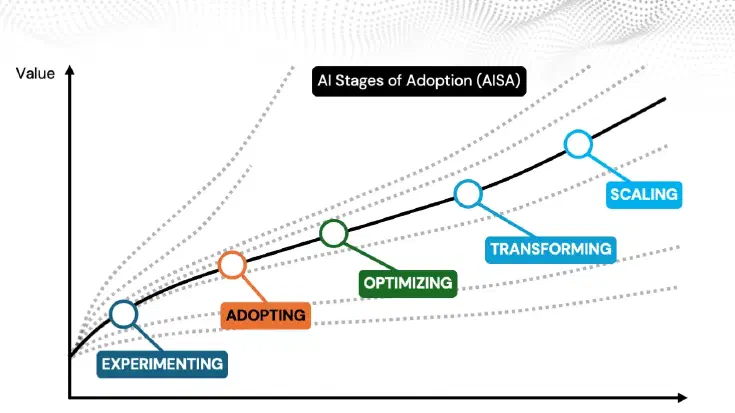
Understanding the AI Stages of Adoption: A framework for business leaders
The AI Stages of Adoption locate an organisation, function by function, on a five-stage path from Experimenting to Scaling, and show how to move.

Demystifying data monetisation: Insights for private equity portfolio companies
Data turns into value when a portfolio company knows what it holds and how to use it: my Chief Wine Officer talk for private equity.

AI is transforming governance: Six key Boardroom priorities
AI takes Boards from overseeing hundreds of decisions a day to millions a second, each needing to be transparent, explainable and correct: six priorities follow.

The enterprise data advantage: Turning information assets into strategic value
Data becomes an asset when its structure, meaning, and relationships are known. A 1998 newspaper archive taught me how information turns into value.

The future of AI expertise: Building and managing AI-capable teams
AI's promise of productivity and innovation is delivered by teams, not tools. Building AI-capable teams draws on what the Cloud Centre of Excellence taught me.

Measuring AI value: A strategic framework for Boards and business leaders
Measuring AI value needs more than total cost of ownership. A strategic framework for Boards, built on what the cloud business case taught me.

Selecting your enterprise LLM: Moving beyond the hype to make the right choice
With well over a hundred language models available, choosing one is a question of fit, not headlines: match the model to the task.

Europe's AI challenge: Why culture trumps capital in technology adoption
Europe's lag in AI adoption is not a shortage of capital. Seen from San Francisco, the difference is culture: openness to transformation, not money.
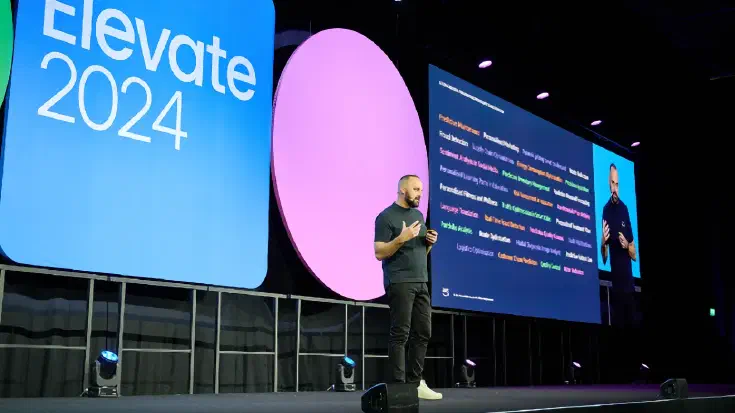
Unlocking your data with AI: Insights from Monday.com Elevate
From my Monday.com Elevate keynote: the misconceptions about AI adoption, and how to put the data an organisation already has to work.

Beyond the hype: Unlocking the true potential of AI in business
Generative AI is one branch of artificial intelligence, not the whole story. Chasing only the hype misses the kinds of AI already creating value.

Introducing the AI Stages of Adoption: A framework for understanding AI readiness in your business
The AI Stages of Adoption, introduced for private equity firms and their portfolio companies: a five-stage framework for reading AI readiness and value creation.
No articles match that filter. Clear the filter.
Agentic AI Explained: From Human Control to Machine Autonomy
What changes when AI stops advising and starts acting: delegated authority, the governance question it raises, and what Boards should be asking before the shadow agentic wave arrives.
Board Briefings
For directors who want to go deeper, my Board Briefings bring the related writing, evidence, and practical questions together in one place.

AI Strategy
From accumulating pilots to a strategy the Board owns

AI Governance
Governing AI the Board cannot fully see, without strangling it

AI Transformation
Crossing from pilots to enterprise-scale change

Operating AI
Building the Centre of Excellence that scales adoption
The ideas that underpin my writing
Ideas I’ve named and matured writing about AI: what each one means, and where it started.
Accountability Gap
When an organisation delegates work to AI without building the capability to verify it, leaving people answerable for outputs no one has actually checked. For a Board, no delegation to AI should be approved without also approving who checks the output and how, because accountability without a verification step is accountability in name only.
Adaptive Localisation
A strategy of running different AI approaches in different markets, tuned to each market's regulatory, cultural, or competitive conditions, deliberately trading consistency for regional advantage. For a Board, choosing this stance means accepting real complexity costs and being ready to answer why the organisation treats one market's rules differently to another's.
AI Capability Bifurcation
The split between workers who build genuine capability to verify and apply judgement to AI outputs, who command a premium, and those who merely accumulate credentials or tool exposure, who face an earnings penalty. For a Board, the same divide runs through the boardroom itself: familiarity with AI tools is not the same as the capability to challenge what the organisation actually does with them.
Signals
My early reads on technologies and ideas that are starting to matter, while the picture is still forming.
Agentic AI
Generative models are being given goals, tools, and the authority to act. The Board question is where to transfer agency, and under what limits.
Embodied AI
AI that acts in the physical world, from factory humanoids to autonomous machines. The liability, capital, and workforce questions are already Board-level.
Knowledge Graphs
Knowledge graphs make relationships and provenance explicit, helping enterprise AI produce answers that are more consistent, traceable, and easier to govern.
Remake
The models, diagnostics, methodologies, and principles from the Remake Library that I use when working through AI strategy, adoption, governance, and value.
- Diagnostic AI CoE Simulator An interactive assessment tool operationalising the AI Stages of Adoption, objectively placing each business function within adoption stages using specific criteria rather than subjective self-assessment, revealing an organisation's multi-speed AI reality.
- Diagnostic AI Initiative Rubric A pilot evaluation tool that scores candidate initiatives across the five Well-Advised value priorities and Five Pillars capability building, recommending whether to prioritise, defer, pipeline, or develop them further.
- Diagnostic AI Amnesty Questionnaire The structured instrument for running an AI amnesty: ten sections capturing which tools employees actually use, the use cases they serve, the data they touch, the value already created, and the risks encountered, turning unknown unknowns into a governable inventory.
- Model AI Sovereignty Trilemma The proposition that organisations and jurisdictions can optimise their AI posture for trust, speed or control, but not all three simultaneously, forcing deliberate strategic positioning rather than attempting to serve every market at once.
- Model AI Stages of Adoption A framework describing five stages of the AI journey, Experimenting, Adopting, Optimising, Transforming and Scaling, plotted on an investment-value graph, recognising that different functions progress simultaneously at different paces.
- Diagnostic Five Pillars of AI Capability The five capability domains of an AI capability model that cut across every level of maturity: Governance and Accountability, Technical Infrastructure, Operational Excellence, Value Realisation and Lifecycle Management, and People, Culture and Adoption.
- Principle Well-Advised The framework of five strategic priorities, Innovation, Customer Value, Operational Excellence, Responsible Transformation, and Revenue, used to ensure AI investments create balanced value rather than narrow cost reduction.
- Diagnostic Well-Advised Assessment The measurement instrument of the Well-Advised principle: an assessment of the value an AI investment is actually realising across the five strategic priorities, returning a balanced-value reading rather than a single ROI number.
Questions Boards ask about Artificial Intelligence
Why do you think you need AI?
Not which AI, and not how much, but why any. Work with one right answer belongs with deterministic tools: a balance reconciles or it does not. A model is the right instrument for judgement, where the best available is a reasoned view of an uncertain situation. Handing a fixed question to a probabilistic tool licenses it to decide afresh on every run, and it will.
Where is AI changing the work itself in our organisation, and how fast?
The three states, augmenting, restructuring, and substituting, are a direction of travel, not fixed positions: work augmented today may be restructured within two years and substituted within five, and the pace differs by dimension. Placing each of thinking, deciding, creating, and delivering on that trajectory separately, with evidence rather than instinct, is the diagnostic that determines the strategic response. The dimension moving fastest in your sector is where the strategy needs the most precision.
What stage of our AI journey are we in?
Answer it per function, not for the organisation as a whole: the multi-speed reality means marketing may be Optimising while operations is still Experimenting. Placement uses evidence against the stage criteria, not self-assessment: what is actually deployed, governed, and delivering, function by function. The honest map is the starting point every subsequent decision builds on.
Are our people doing more valuable work, or simply work with AI tools?
The BCG comparison answers what the difference looks like: 67% of employees save more than an hour daily where workflows are redesigned around AI, against 49% where tools are deployed inside unchanged processes. The premium comes from the capability to redesign work. If the work itself is unchanged, the tools are decoration and the time savings are marginal.
Which decisions will AI increasingly make, and who bears the consequences when it does?
Deciding is the dimension with the tension no other shares: AI can assume the agency of assessing, recommending, and acting, but accountability does not transfer with it. An underwriter’s value is the signature, a Board’s value the commitment. As decision substance migrates to AI while sign-off structures stay unchanged, the question of who bears the consequence when it is wrong keeps its old answer, the humans at the top, while the difficulty of exercising that accountability grows.