
The Principle of Least Intelligence: How Much AI Does the Work Need?
· 14 minute read
Apply no more intelligence than the outcome needs: the Principle of Least Intelligence matches capability to the work, with permission to act decided separately.
If you're on a Board or leading an organisation, you're navigating the same artificial intelligence and emerging technology disruption I am. Here I cut through the hype to offer a clear-eyed perspective on the things that deserve your time.
My long-form pieces for directors and senior leaders, where I take a question on AI or emerging technology and work it all the way through. This is where the analysis and the frameworks live.
Apply no more intelligence than the outcome needs: the Principle of Least Intelligence matches capability to the work, with permission to act decided separately.

Most AI business cases count the time agents save; the saving becomes real, or not, in the manager's workflow, a job rarely redesigned for it.

Access to the frontier is now something the supplier allocates, not something the customer buys. The accountability for depending on it stays with the Board.

Frontier AI may pass an organisation's know-how to a model its competitors can buy. A Board governs that by deciding which work goes in.

AI now writes the code and does the debugging that taught developers to check it. Verification demand rises as the route to building it weakens.
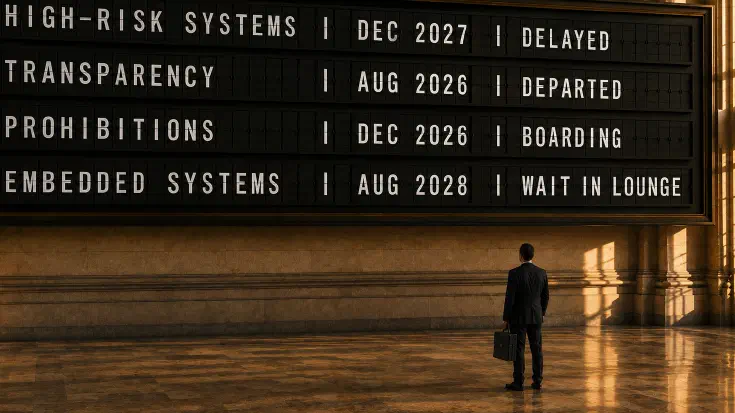
The EU deferred its AI Act high-risk obligations six days before they applied. What a moving deadline reveals about where Board governance is anchored.
AI doesn’t transform businesses. It remakes the essence of the work you do: thinking, deciding, creating, and delivering. Remake is my framework for leading and executing that change deliberately, so the strategy, governance, and investment questions get answered in the right order, as they arrive.
Each briefing pulls together everything I have on one area of AI or emerging technology, the articles, frameworks, and tools, into a single complete resource. For the Boards that need the full picture rather than a quick read.

How AI is transforming the very essence of work

From accumulating pilots to a strategy the Board owns

What AI asks of every seat around the table

Governing AI the Board cannot fully see, without strangling it

What fragmented AI regulation demands of directors

Building the Centre of Excellence that scales adoption

Investment cases that survive contact with the Board

Talent, skills, and the people side of adoption
At the IoD's half-day Director Forum at 116 Pall Mall, the event that launches the 2026 IoD Commission report, I'm chairing the breakout panel “Disruptive Tech: a board's best friend or worst enemy?” with Rob McCargow of PwC UK, Niresh Rajah and Maya Bankovich. Members only.

In this session in the AWS re:Invent 2026 Senior Leaders track (SNR310), Taimur Rashid and I will show you how to read where your Board's attention on AI is going, where it is better spent, and which questions to take back to its next meeting.

Short, early reads on the emerging technologies Boards are starting to hear about. My take on what each one is and why it might matter, before the hype catches up.
AI that acts in the physical world, from factory humanoids to autonomous machines. The liability, capital, and workforce questions are already Board-level.
Quantum error correction has crossed important experimental thresholds. The Board question is how to time readiness against evidence, not vendor roadmaps alone.
Quantum-resistant cryptography standards are published and migration targets set. Data stolen today may be decrypted later, which makes the transition a Board question now.
Knowledge graphs make relationships and provenance explicit, helping enterprise AI produce answers that are more consistent, traceable, and easier to govern.
Formal logic and mathematical proof, industrialised. For some precisely specified, high-consequence controls, testing is no longer the strongest assurance available.
Generative models are being given goals, tools, and the authority to act. The Board question is where to transfer agency, and under what limits.
Each month I pull my recent articles into a single digest, with added analysis that ties the topics together and draws out what they mean for Boards. A month of AI and emerging technology in a single read.
The audio edition of my long-form articles on AI and what it means for Boards, for when you’d rather listen than read. Subscribe on Apple Podcasts, Spotify, Amazon Music, and Pocket Casts.
Across my work, I’ve developed ideas that hold steady while the technology changes. Each is something I’ve named and matured across my writing: what it means, and where it started.
AI changing the essence of work rather than merely its tools: the redistribution of judgement, the bifurcation of the workforce, and what organisations owe the people whose roles are remade. The frame that lets a Board govern workforce transition as a strategic programme, not an HR afterthought.
A framework describing five stages of the AI journey, Experimenting, Adopting, Optimising, Transforming and Scaling, plotted on an investment-value graph, recognising that different functions progress simultaneously at different paces.
Every organisation does four kinds of work: thinking, deciding, creating, and delivering, and AI is remaking all four. Remake is how a Board governs that remaking and how an organisation executes it: establishing what the work is, who does the remaking, who is accountable for it (a gate, not a description; where genuine agency or durable accountability is absent, the remaking does not begin), what the verdict on the work is (Stop, Keep, or Change), and how it is done through the ADAPT motion. The mature successor to the Complete AI Adoption Framework.
The proposition that organisations and jurisdictions can optimise their AI posture for trust, speed or control, but not all three simultaneously, forcing deliberate strategic positioning rather than attempting to serve every market at once.
When an organisation delegates work to AI without building the capability to verify it, leaving people answerable for outputs no one has actually checked. For a Board, no delegation to AI should be approved without also approving who checks the output and how, because accountability without a verification step is accountability in name only.
Long-form papers for ideas that need more than an article: technical architectures with working reference implementations, and formal instruments for the Board. Every paper is versioned, citable, and ships as a downloadable PDF.